Barlow Lens vs Dedicated Eyepiece: Optical Showdown
Choosing between a multiplier lens and a single focal length defines your high-magnification planetary viewing. Understanding optical compromises helps you build a sharper telescope kit.

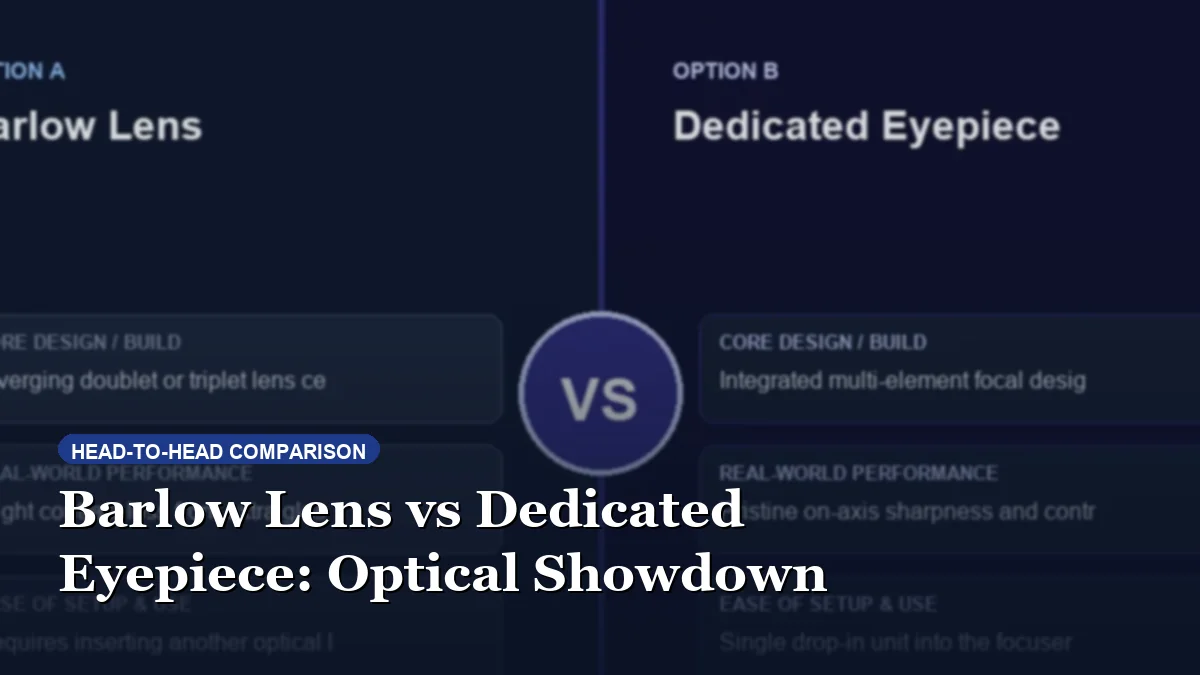
Choose a Barlow lens to double your current magnification inventory cheaply, but pick a dedicated eyepiece if you demand maximum contrast without extra glass surfaces.
Compare all top models in our Best Telescope: Top Backyard Picks for Astronomy.
Side-by-Side Breakdown
| Criteria | Barlow Lens | Dedicated Eyepiece | Edge |
|---|---|---|---|
| Core Design / Build | Diverging doublet or triplet lens cell | Integrated multi-element focal design | Dedicated Eyepiece |
| Real-World Performance | Slight contrast loss from extra glass | Pristine on-axis sharpness and contrast | Dedicated Eyepiece |
| Ease of Setup & Use | Requires inserting another optical layer | Single drop-in unit into the focuser | Dedicated Eyepiece |
| Durability & Reliability | Fewer moving parts, highly durable barrel | Complex internal assemblies susceptible to shock | Barlow Lens |
| Efficiency / Operating Footprint | Doubles usefulness of existing eyepieces | Demands carrying multiple heavy focal lengths | Barlow Lens |
| Maintenance Requirements | Cleaning four total glass surfaces minimum | Standard cleaning of two outer elements | Dedicated Eyepiece |
| Best Ideal Use Case | Budget expansion of planetary magnifications | Uncompromised wide-field deep sky views | Dedicated Eyepiece |
Core Design and Engineering Differences
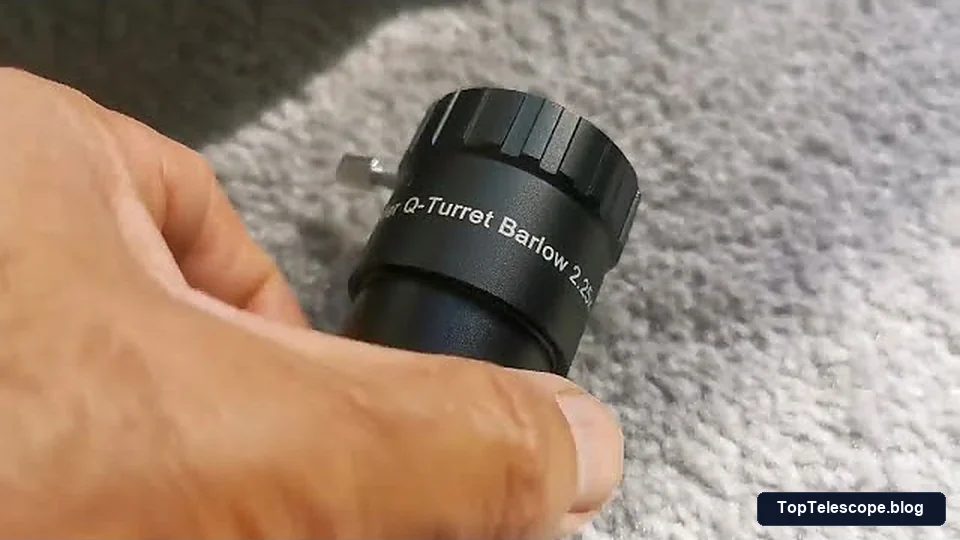
Optical engineers approach high magnification through two completely different paths. A Barlow lens diverges light rays before they reach the focal plane, artificially extending your telescope focal length.
Conversely, a dedicated eyepiece uses a complex internal arrangement of polished glass elements. This design handles the raw cone of light directly from your primary mirror without preliminary divergence.
Understanding these foundational layouts clarifies why each tool behaves differently under demanding atmospheric conditions. Glass quality, coating types, and mechanical housing tolerances dictate final image fidelity across both systems.
When selecting equipment, choosing the best barlow lens for dobsonian setups guarantees sharper views. A diverging negative lens doublet housed in a metal barrel effectively multiplies your focal length by 2x or 3x.
Dedicated short focal length eyepieces contain complex internal groupings of four to seven elements. These optical designs manage magnification internally without requiring an external lens cell placed ahead of the focal plane.
Understanding these core construction variances helps astronomers choose between modifying an existing optical train and investing in a standalone eyepiece unit designed explicitly for high power planetary observation sessions.
- Barlow lenses utilize diverging concave optical elements.
- Dedicated eyepieces contain integrated positive and negative lenses.
- Focal extension alters effective eye relief differently per design.
Optical Layouts and Glass Elements
A standard achromatic Barlow features a cemented doublet glass pair. Premium models employ three elements to control off-axis aberrations and maintain flat field performance.
Dedicated eyepieces often house four to eight distinct optical elements. These configurations correct complex aberrations like field curvature and astigmatism natively within the single housing.
- Doublet and triplet configurations are common in multipliers.
- Wide-field eyepieces require heavy multi-element corrective groupings.
Magnification Mechanics
Inserting a multiplier scales your existing focal length by a fixed factor. A two-times unit instantly turns your standard twenty-millimeter glass into a ten-millimeter high-power observer.
Dedicated models achieve specific focal lengths through fixed internal spacing. Changing magnification requires physically swapping one complete housing for another inside your focuser drawtube.
- Multipliers double or triple your current eyepiece lineup.
- Dedicated units provide fixed, highly optimized focal lengths.
Real-World Performance Comparison
Observing fine planetary details tests the absolute limits of your optical train. Adding extra air-to-glass surfaces via a multiplier can introduce subtle scatter and reduce faint lunar contrast.
Using a purpose-built short focal length eyepiece eliminates that extra glass layer. Light travels straight from the diagonal mirror into the polished surfaces without intermediate divergence.
Atmospheric seeing conditions frequently mask these subtle laboratory differences during backyard viewing sessions. However, sharp night skies reveal distinct advantages for uncompromised single-piece optical designs.
When viewing faint deep sky targets, learning proper techniques via our 2x barlow lens guide helps maintain comfortable eye relief. You retain usable viewing distances even when pushing magnification on small lunar features.
Conversely, short focal length dedicated eyepieces sometimes suffer from tight eye relief specs in simpler designs like Plossls. Premium wide field alternatives bypass this issue using built in internal amplifier elements.
Field testing reveals that optical throughput varies significantly based on glass quality and multicoating standards. Evaluating how each setup handles atmospheric seeing dictates your final choice during steady nights.
- Extra glass layers increase internal light scatter risks.
- Single units preserve maximum lunar terminator contrast.
- Atmospheric turbulence often dictates final planetary resolution.
Sharpness and Contrast
High-grade multiplier units employ broadband anti-reflective coatings to minimize light loss. Even so, pristine dedicated glass frequently yields darker backgrounds and punchier planetary details.
Meticulous blackening of internal barrel threads prevents stray reflections. Both designs benefit tremendously from high transmission coatings applied across all active optical surfaces.
- Broadband coatings maintain high transmission efficiency.
- Internal barrel baffling eliminates unwanted stray reflections.
Field of View and Eye Relief
Pairing a multiplier with a long eye-relief eyepiece preserves comfortable viewing distances. Plossl designs typically suffer from tight eye relief at short focal lengths.
Modern wide-field eyepieces maintain generous eye relief even at high magnifications. This ergonomic benefit lets observers view extended star clusters without pressing against the glass.
- Multipliers preserve comfortable eye relief on simple designs.
- Wide-field housings provide immersive apparent fields of view.
Maintenance, Efficiency and Longevity
Field maintenance routines differ significantly between these two optical categories. Keeping multiple glass surfaces clean requires disciplined cleaning techniques and proper protective storage habits.
Durability depends heavily on mechanical housing construction and anodized aluminum quality. Both accessories withstand normal field usage when protected inside padded accessory cases.
Operating efficiency favors the multiplier when traveling light to dark sky sites. Carrying one versatile lens replaces several heavy dedicated focal lengths in your field kit.
Dust accumulation requires careful cleaning protocols for complex optical systems. Following our celestron barlow lens guide ensures you properly wipe exposed two glass surfaces using certified microfibre cloths and cleaning fluid.
Dedicated eyepieces often feature recessed exterior lenses protected by rubber eyecups, minimizing accidental finger smudges. Proper storage inside padded aluminum cases prevents internal mechanical misalignment over years of field deployment.
Mechanical wear on compression rings and barrel threading can degrade alignment accuracy. Maintaining clean threads ensures smooth focusing movement without introducing unwanted tilt into your telescope optical train.
- Multipliers reduce total accessory weight in travel kits.
- Protective caps prevent dust accumulation on internal lenses.
- Robust aluminum barrels resist scratching from compression rings.
Cleaning Protocols and Coatings
Recessed multiplier lenses collect dust in hard-to-reach internal cells. Cleaning requires careful compressed air application alongside high-purity optical cleaning fluids.
Exposed eyepiece elements allow much faster routine maintenance in the field. Routine bulb blower use safely removes loose debris without risking delicate anti-reflective coatings.
- Recessed elements demand careful cleaning tool handling.
- Exposed outer lenses simplify rapid field maintenance.
Mechanical Wear and Housing Integrity
Focusers experience added torque when supporting heavy multi-element eyepieces. Balancing your telescope OTA prevents unwanted slip during high-magnification tracking sequences.
Brass compression rings protect shiny metal barrels from deep gouges. Quality thumb screws ensure secure locking without marring your precision telescope equipment.
- Heavy optical assemblies require balanced telescope mounts.
- Compression rings prevent unsightly barrel scratching issues.
Optical Aberrations and Light Transmission
Controlling chromatic aberration remains a primary engineering challenge for high-power optics, much like managing distortion when testing a smartphone telephoto lens. Diverging elements introduce false color if glass types are poorly matched.
Special low-dispersion glass elements effectively eliminate purple fringing around bright lunar craters. Premium multi-element designs utilize exotic fluorite substitutes to achieve true apochromatic correction.
Light transmission percentages dictate overall image brightness across both configurations. High-end broadband coatings ensure over ninety-nine percent light throughput per air-to-glass boundary.
Adding extra glass elements inevitably introduces minor optical aberrations like chromatic fringing. High quality achromat or apochromat Barlow lenses use ED glass to minimize color dispersion effectively.
Dedicated eyepieces optimize light transmission by matching internal element curves specifically to short focal lengths. Anti reflective broadband coatings maximize photon yield across the visible spectrum for sharper planetary contrast.
Evaluating scatter and ghost reflections helps identify inferior optical builds. Premium configurations maintain high contrast ratios even when viewing bright celestial objects against dark background skies.
- Low-dispersion glass minimizes annoying chromatic fringing.
- Broadband coatings maximize total optical light transmission.
- Poorly matched doublets introduce unwanted false color.
Managing Chromatic Fringe
Bright targets like Jupiter and Venus expose cheap optical flaws instantly. Selecting properly figured glass elements ensures crisp planetary limbs without purple halos.
Achromatic multiplier units handle color correction surprisingly well across standard focal ratios. Fast Newtonian systems demand telecentric designs to prevent off-axis chromatic spread.
- Fast focal ratios demand superior optical correction.
- Telecentric systems maintain consistent magnification factors.
Transmission Losses in Multi-Element Glass
Every glass surface reflects a tiny percentage of incoming starlight. Stacking multiple elements accumulates transmission losses that slightly dim faint deep-sky nebulae.
Planetary observers rarely notice minor transmission drops against bright targets. Dedicated single-purpose glass excels when viewing threshold magnitude double stars.
- Stacked glass surfaces accumulate minor transmission losses.
- Planetary brightness masks subtle contrast reductions effectively.
Ergonomics and Field Usability
Cold night operations test the physical handling of all astronomy gear. Swapping small accessories in absolute darkness demands intuitive tactile design and secure grip surfaces.
Knurled rubber rings provide positive traction when wearing thick winter gloves. Preventing accidental drops onto hard concrete protects your expensive glass investments.
Streamlined workflows keep viewing sessions enjoyable and productive. Minimizing unnecessary equipment swaps preserves your dark adaptation during long observation marathons.
Changing eyepieces in cold darkness requires tactile familiarity and secure grip designs. Knurled metal grips prevent accidental drops while handling heavy accessories with gloved hands during winter observing runs.
A Barlow lens alters the physical balance point of your telescope setup by extending the optical train outward. Managing this center of gravity shift prevents strain on motorized equatorial mounts.
Dedicated short focal length eyepieces keep your rig compact and balanced without extra extension barrels. This integrated physical profile enhances comfort during extended public outreach and deep sky marathons.
- Knurled grip rings prevent drops in cold weather.
- Tactile design aids rapid accessory swaps in darkness.
- Streamlined workflows protect valuable night vision adaptation.
Swapping Speed in the Dark
Inserting a multiplier into your optical train takes precious seconds. Quick-lock mechanisms speed up field adjustments without fumbling with tiny thumb screws.
Pre-planning your viewing sequence minimizes the need for frantic gear changes. Having ready-to-use dedicated pieces eliminates intermediate adapter steps entirely.
- Quick-lock adapters accelerate nighttime equipment changes.
- Pre-planned observation lists reduce field fumbling.
Balancing Heavy Gear Trains
Massive wide-field eyepieces shift the balance point of small scopes. Adjusting your dovetail rail ensures smooth tracking across celestial coordinate axes.
Lightweight multiplier units exert minimal leverage against focusers. This stability benefits budget rack-and-pinion focusers prone to sagging under heavy loads.
- Massive eyepieces alter telescope balance points.
- Lightweight multipliers protect fragile rack-and-pinion focusers.
Which Option Fits Your Setup
Building an optimized kit requires evaluating your current eyepiece inventory. If you already own high-quality focal lengths, a multiplier offers cost-effective expansion.
Observers starting fresh often benefit from purchasing core dedicated eyepieces. This approach guarantees uncompromised optical performance from your primary telescope system.
Consider your primary targets before purchasing additional hardware. Lunar and planetary specialists prioritize contrast, while wide-field fans demand immersive apparent fields.
Choosing the right optical accessory depends heavily on your existing eyepiece collection and budget. Budget conscious observers often maximize value by pairing a quality Barlow with standard Plossl oculars.
Advanced astrophotographers and planetary specialists prefer dedicated high power eyepieces to minimize glass interfaces. Eliminating an intermediate lens cell preserves maximum optical resolution for capturing fine planetary details.
Assess your specific viewing priorities, telescope focal ratio, and physical mounting capacity before making a purchase. Balancing versatility against optical purity guarantees long term satisfaction with your observing gear.
- Evaluate existing focal lengths before buying upgrades.
- Planetary observers prioritize high-contrast single glass.
- Budget-conscious astronomers benefit greatly from quality multipliers.
Building a Minimalist Kit
Traveling astronomers appreciate lightweight, compact accessory cases. Pairing a versatile multiplier with two premium eyepieces covers every useful magnification.
Reducing total gear weight prevents fatigue during remote camping expeditions. Streamlined setups get you observing faster under pristine dark skies.
- Minimalist kits reduce travel weight significantly.
- Versatile setups maximize observing efficiency outdoors.
Maximizing Planetary Resolution
High-resolution lunar viewing demands absolute optical purity. Premium dedicated focal lengths deliver the crispest planetary details possible.
Investing in specialized high-power glass rewards dedicated planetary astronomers. Clean optical paths reveal subtle cloud belts and elusive double stars.
- Planetary details demand pristine optical paths.
- Specialized glass reveals subtle atmospheric cloud belts.
Frequently Asked Questions
Does a Barlow lens reduce telescope image brightness?
Multipliers slightly reduce image brightness due to extra glass surfaces. However, the loss is negligible for bright planetary targets.
Can I use a Barlow lens with any telescope eyepiece?
Yes, standard 1.25-inch and 2-inch barrels fit universally. Always ensure proper physical clearance inside the star diagonal.
Are dedicated eyepieces always sharper than multipliers?
High-end multipliers match many single units. Premium glass quality ensures minimal visible degradation during normal viewing.
How do I calculate magnification with a multiplier?
Multiply your telescope focal length by the factor. Then divide by your eyepiece focal length to find power.
Which option is better for beginners on a budget?
A quality multiplier expands existing focal lengths affordably. This strategy provides immediate magnification growth without buying multiple pieces.