Astromaster 130Eq vs Powerseeker 127Eq: Concise Verdict
Evaluating the Celestron AstroMaster 130EQ against the PowerSeeker 127EQ reveals critical differences in Newtonian optical physics, mount stability, and overall beginner usability for amateur astronomers.

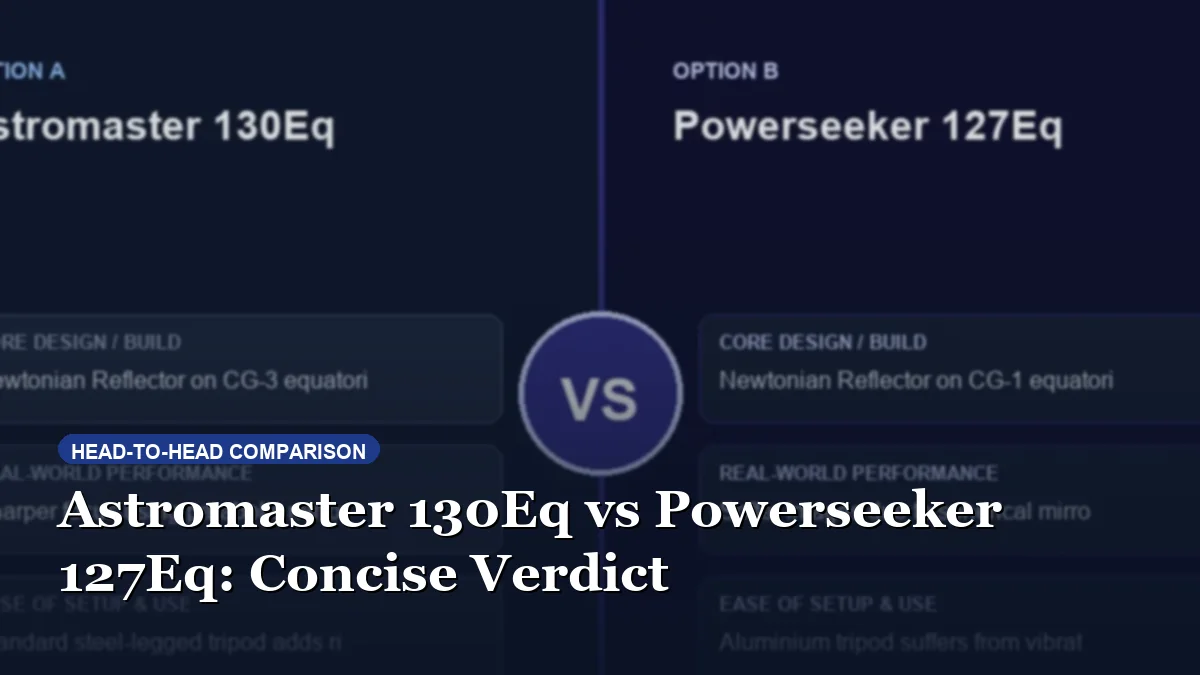
Choose the AstroMaster for its true parabolic primary mirror that delivers sharper high-magnification views. Opt for the PowerSeeker only if strict budget constraints force acceptance of a spherical mirror with a corrector lens.
Compare all top models in our Best Telescope: Top Backyard Picks for Astronomy.
Side-by-Side Breakdown
| Criteria | Astromaster 130Eq | Powerseeker 127Eq | Edge |
|---|---|---|---|
| Core Design / Build | Newtonian Reflector on CG-3 equatorial mount | Newtonian Reflector on CG-1 equatorial mount | AstroMaster 130EQ |
| Real-World Performance | Sharper focus using parabolic mirror optics | Softer images due to spherical mirror design | AstroMaster 130EQ |
| Ease of Setup & Use | Standard steel-legged tripod adds rigidity | Aluminium tripod suffers from vibration issues | AstroMaster 130EQ |
| Durability & Reliability | Sturdier counterweight bar and cast metal housing | Lighter plastic components prone to wear | AstroMaster 130EQ |
| Efficiency / Operating Footprint | Wider tube requires balanced counterweight positioning | Shorter optical tube utilizes internal erecting lens | PowerSeeker 127EQ |
| Maintenance Requirements | Standard user collimation via primary mirror cell | Factory-sealed corrector lens complicates mirror cleaning | AstroMaster 130EQ |
| Best Ideal Use Case | Deep-sky viewing and serious lunar observation | Casual backyard stargazing on a tight budget | AstroMaster 130EQ |
Optical Design and Primary Mirror Architecture
Understanding the fundamental glass architecture determines how each telescope processes incoming starlight. The optical tube assembly relies on Newtonian reflector principles to gather photons effectively across various celestial wavelengths.
Internal baffling and tube interior blackening reduce stray reflections, maximizing contrast when observing faint deep-sky nebulae. Proper baffling prevents ambient suburban light pollution from washing out subtle planetary details.
As detailed in our celestron astromaster 130eq review, this telescope utilizes a true parabolic primary mirror measuring 130mm, effectively eliminating spherical aberration to yield sharp focal points at fast f/6.5 focal ratios.
Conversely, the PowerSeeker 127EQ features a spherical mirror paired with a built-in corrector lens inside the drawtube, which complicates exact collimation procedures and reduces overall optical clarity significantly.
- AstroMaster 130EQ utilizes a 130mm aperture mirror.
- PowerSeeker 127EQ features a 127mm aperture configuration.
- Both gather substantial light for beginner astronomy.
Focal Length and Aperture Trade-offs
Aperture diameter dictates light-gathering capability, directly influencing the visibility of faint galaxies and star clusters. Longer focal lengths inherently provide higher native magnification with standard eyepieces.
Balancing physical tube length with optical focal length creates distinct handling characteristics during field deployment and nighttime observation sessions under dark skies.
- AstroMaster focal length measures 650mm.
- PowerSeeker focal length measures 1000mm.
Equatorial Mount Mechanics and Tracking Stability
Equatorial mounts compensate for Earth's rotation, allowing smooth tracking of celestial objects across the night sky. Correct polar alignment transforms complex manual tracking into a single-axis adjustment procedure.
Mount rigidity directly dictates how quickly vibrations dissipate after touching the focus knobs or adjusting telescope orientation during high-magnification planetary viewing sessions.
Both instruments employ CG-3 equatorial mounts featuring aluminum tripods, but the AstroMaster leverages slightly thicker gauge steel legs to dampen high-frequency vibrations during manual focusing operations.
Smooth right ascension tracking requires proper polar alignment using the latitude scale, though balancing heavy optical tube assemblies demands careful counterweight placement along the solid steel shaft.
- CG-3 mount provides sturdier tracking on the AstroMaster.
- CG-1 mount on the PowerSeeker offers lighter payload capacity.
Counterweight Balancing and Setting Circles
Precise counterweight balancing prevents excessive wear on the internal worm gears and ensures effortless manual panning. Setting circles assist in locating coordinates using celestial maps.
Proper balance remains entirely essential for maintaining smooth tracking performance throughout extended observation sessions without placing undue mechanical strain on the axes.
- Counterweights balance heavy optical tube assemblies.
- Setting circles require accurate polar alignment calibration.
Optical Tube Assembly Build Quality and Materials
Discussed further in our powerseeker 127eq review, exterior housing construction determines how well instruments withstand frequent transport and environmental humidity exposure during overnight stargazing excursions. Metal components offer superior structural integrity.
Internal cell construction holds primary and secondary mirrors in precise alignment despite temperature fluctuations encountered between indoor storage and outdoor viewing locations.
Aluminum optical tube assemblies on both models offer lightweight durability, yet the AstroMaster utilizes a rigid metal cell for mirror retention compared to plastic components on cheaper variants.
Internal baffling painted with matte black coatings helps suppress stray ambient light reflections, while securely fastened dovetail mounting bars allow quick attachment to equatorial mount saddle plates.
- Aluminum tube construction provides robust exterior protection.
- Plastic mounting rings require careful tightening procedures.
Focuser Mechanics and Eyepiece Compatibility
Rack and pinion focusers manage eyepiece insertion depth, ensuring crisp image acquisition across variable magnification ranges. Smooth gear engagement prevents image jumping during fine focus adjustments.
Standard diameter compatibility allows users to upgrade basic factory eyepieces with advanced Plossl or wide-field glass elements for vastly enhanced viewing experiences.
- Standard 1.25-inch focuser drawtubes accept universal filters.
- Rack and pinion systems require periodic tension checks.
Field Setup, Ergonomics, and Portability
Transporting telescope gear to dark-site locations demands manageable weight distribution and straightforward assembly procedures that can be completed under red flashlight illumination.
Ergonomic knob placement and intuitive locking levers reduce user frustration when adjusting altitude and azimuth axes during cold nighttime outdoor observing sessions.
Field assembly relies on hand-tightened thumbscrews and accessory trays that lock the tripod spreader legs securely, providing a stable footprint on grass or packed soil observing locations.
Because equatorial heads require counterweights and setting circles, total transport weight exceeds fifteen pounds, demanding manageable trips from storage areas to your backyard viewing spot.
- AstroMaster total weight equals approximately twenty-seven pounds.
- PowerSeeker features a slightly lighter structural footprint.
Tripod Footprint and Assembly Complexity
Tripod leg spread creates a stable foundation on grass, dirt, or paved surfaces, minimizing annoying vibrations caused by footsteps or gentle wind gusts.
Central accessory trays lock tripod legs into rigid alignment while providing convenient storage space for extra eyepieces and small cleaning tools.
- Steel legs offer superior dampening compared to aluminum.
- Accessory tray installation secures the central tripod spreader.
Collimation Requirements and Maintenance Standards
Reflector telescopes require occasional mirror alignment procedures to maintain optimal optical performance and sharp planetary resolution during high-power viewing sessions.
Understanding user-adjustable collimation screws empowers owners to service their primary optics without resorting to expensive professional instrument calibration services.
Newtonian reflectors demand periodic alignment of primary and secondary mirrors using a cheshire eyepiece or laser collimator to maintain pinpoint star images at high magnification thresholds.
As highlighted in our celestron powerseeker 127eq review, this spherical optical design makes traditional mirror alignment uniquely challenging because the internal corrector lens introduces an additional optical element that must remain undisturbed.
- Primary mirror cells feature adjustable collimation thumbscrews.
- Factory corrector lenses complicate routine maintenance tasks.
Mirror Alignment and Dust Protection
Dust accumulation on optical surfaces degrades contrast over time, necessitating careful cleaning using specialized optical grade microfiber materials and cleaning solutions.
Dust caps should always remain securely attached whenever the instrument is stored indoors to protect delicate reflective coatings from environmental contamination.
- Keep dust covers on during daytime storage periods.
- Never touch bare mirror surfaces with fingers.
Planetary, Lunar, and Deep-Sky Performance Profiles
Observing fine planetary details like Saturn rings or Jupiter cloud bands demands crisp optical resolution and adequate contrast handling from the primary mirror.
Deep-sky targets require maximum light-gathering aperture to reveal faint spiral galaxy structures and distant nebulae previously hidden from naked-eye observations.
As evaluated in our astromaster 130eq review, lunar craters and Jovian cloud belts appear crisp through the scope when paired with quality eyepieces, benefiting from an unobstructed parabolic optical train delivering clean high-contrast views.
Faint deep-sky objects like the Orion Nebula remain visible under dark skies, though light pollution filters and proper dark adaptation are essential for resolving subtle nebulosity details.
- Parabolic mirrors eliminate spherical aberration entirely.
- Barlow lenses double effective eyepiece magnification power.
Magnification Limits and Barlow Lens Usage
Maximum useful magnification depends directly on aperture diameter, preventing blurry images caused by pushing optical systems beyond normal physical limits.
Included Barlow lenses expand eyepiece collections economically, though poor atmospheric seeing conditions often limit practical magnification thresholds in the field.
- Calculate magnification by dividing focal lengths.
- Atmospheric turbulence blurs excessive magnification attempts.
Buyer Suitability and Long-Term Value Assessment
Selecting the correct instrument ensures long-term engagement with amateur astronomy rather than abandonment due to operational frustration or poor optical performance.
Investing in superior optical designs yields rewarding views that keep hobbyists motivated through years of continuous planetary and deep-sky exploration campaigns.
Beginner astronomers prioritizing optical fidelity and upgrade potential will find the AstroMaster 130EQ to be a reliable platform for learning equatorial tracking and basic astrophotography techniques.
Prospective buyers should carefully evaluate their storage space and patience levels, ensuring they select an instrument whose physical weight and maintenance demands match their lifestyle constraints.
- AstroMaster suits dedicated beginner hobbyists best.
- PowerSeeker appeals to ultra-casual budget constrained buyers.
Upgradability and Accessory Investments
Standardized drawtubes and mounting plates allow users to add motorized tracking drives, specialized filters, and premium glass eyepieces over time.
Upgrading accessories enhances overall usability without requiring a complete instrument replacement as observational skills steadily advance into astrophotography fields.
- Motor drives automate celestial tracking tasks easily.
- Quality filters enhance lunar surface contrast.
Frequently Asked Questions
Is the AstroMaster easier to collimate than the PowerSeeker?
Yes, because the AstroMaster utilizes a standard parabolic mirror with accessible primary mirror adjustment screws. This design simplifies routine maintenance for amateur astronomers.
Why does the PowerSeeker include a corrector lens?
The PowerSeeker uses a spherical primary mirror that requires an internal corrector lens to fix optical aberrations. This configuration can complicate cleaning procedures inside the tube.
Can these equatorial mounts accept motor drives?
Both mounts can accept optional RA motor drives for automatic celestial tracking. This addition significantly improves high-magnification viewing comfort.
Which telescope is better for deep-sky viewing?
The AstroMaster provides better deep-sky views due to its superior light-gathering parabolic mirror architecture. It reveals faint nebulae and galaxies with greater clarity.
Are the included eyepieces sufficient for beginners?
Both models include basic Kellner eyepieces that offer acceptable starting magnifications. Users typically upgrade to wider-field Plossl eyepieces later.