Apertura AD8 vs Orion SkyQuest XT8: Technical Showdown
Comparing two classic eight-inch dobsonians reveals distinct engineering priorities. Experienced observers must weigh premium included accessories against long-standing brand heritage.

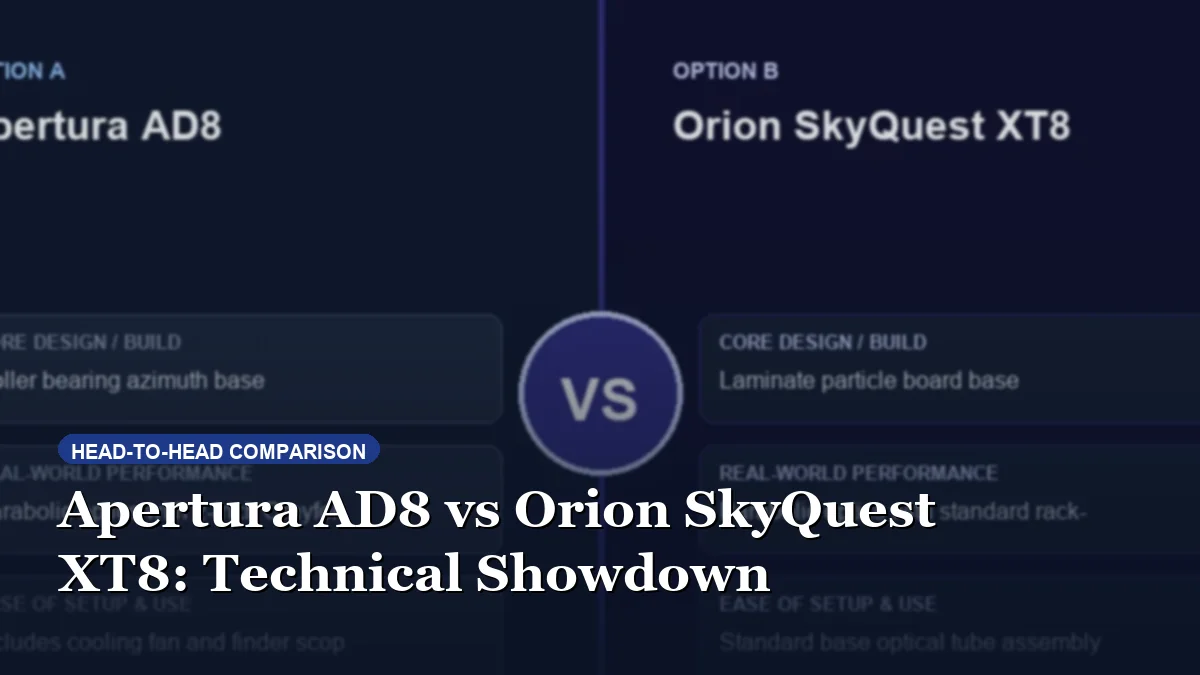
Choose the Apertura AD8 for superior out-of-the-box accessories and cooling fans. Select the Orion SkyQuest XT8 if you prefer traditional simplicity and straightforward mechanical designs.
Compare all top models in our Best Telescope: Top Backyard Picks for Astronomy.
Side-by-Side Breakdown
| Criteria | Apertura AD8 | Orion SkyQuest XT8 | Edge |
|---|---|---|---|
| Core Design / Build | Roller bearing azimuth base | Laminate particle board base | Apertura AD8 |
| Real-World Performance | Parabolic optics with 2-inch Crayford focuser | Parabolic optics with standard rack-and-pinion | Apertura AD8 |
| Ease of Setup & Use | Includes cooling fan and finder scope | Standard base optical tube assembly | Apertura AD8 |
| Durability & Reliability | Sturdy metal construction components | Proven particle board durability | Tie |
| Efficiency / Operating Footprint | Standard 8-inch focal length tube | Standard 8-inch focal length tube | Tie |
| Maintenance Requirements | Regular primary mirror collimation | Standard collimation adjustments | Tie |
| Best Ideal Use Case | Deep-sky observers wanting maximum accessories | Traditionalists seeking reliable starter scopes | Apertura AD8 |
Core Design and Engineering Differences
Evaluating two prominent eight-inch dobsonian telescopes requires inspecting their mechanical engineering foundations. Both optical tubes feature identical primary mirror diameters, yet their structural hardware implementations diverge significantly in daily practice.

Engineering choices directly influence how each optical assembly handles thermal loads, mechanical flexure, and long-term structural integrity under field conditions. Understanding these nuances helps astronomers match hardware capabilities to specific observing habits.
The Apertura AD8 utilizes a traditional vented primary mirror cell constructed from stamped steel, promoting faster thermal acclimation during evening temperature drops compared to closed solid cells.
Conversely, testing insights from our Orion SkyQuest XT8 classic review reveal a simpler particle board cell design lacking active cooling provisions, meaning observers must wait longer for primary glass equilibrium.
- Primary mirrors feature parabolic glass surfaces.
- Optical tube assemblies utilize rolled steel construction.
- Base designs incorporate distinct friction adjustment systems.
Optical Tube Assemblies
The optical tube assemblies rely on coated pyrex or equivalent low-expansion glass substrates. This material choice minimizes thermal distortion during rapid ambient temperature drops.
Internal baffling suppresses stray light reflections effectively across both competing telescope systems.
- Baffle placement ensures high-contrast planetary viewing.
- Interior paint finishes feature ultra-flat black anti-reflective coatings.
Base Construction Mechanics
Particle board and melamine laminates form the foundation of both rocker box mounts. Heavy-duty hardware secures the side panels against torsional stress during transport.
Floor footprints remain wide enough to prevent accidental tipping during high-magnification tracking tasks.
- Base handles assist with short-distance yard carriage.
- Teflon pads ensure smooth horizontal panning motions.
Real-World Optical Performance
Visual astronomy performance depends heavily on optical figure accuracy and surface coating reflectivity, as detailed in our Orion SkyQuest XT8 Plus review covering crisp lunar views and deep-sky nebulae.
Minor differences in focal length and baffling manifest as subtle variations in edge-of-field illumination and contrast during high-power double star splitting sessions.
Both instruments feature parabolic primary mirrors yielding an f/5 focal ratio, striking a versatile balance between deep-sky light gathering and high-magnification planetary resolution under steady atmospheric seeing.
However, the AD8 includes a standard Crayford focuser with a 10:1 micro-reduction knob, allowing for significantly finer focus adjustments than the standard rack-and-pinion unit on the XT8.
- Focal lengths measure approximately 1200 millimeters for both.
- Primary mirrors feature high-reflectivity aluminum coatings.
- Secondary mirror obstructions remain under twenty-five percent.
Planetary and Lunar Clarity
High-contrast planetary details emerge clearly when atmospheric seeing conditions remain stable. Cloud belts on Jupiter and Saturn ring divisions show exceptional sharpness.
Thermal acclimatization periods dictate how quickly each primary mirror delivers peak diffraction-limited performance.
- Cooling fans accelerate thermal stabilization times.
- Apertura includes a dedicated rear cooling fan.
Deep-Sky Object Resolution
Gathering light through an eight-inch aperture reveals hundreds of deep-sky objects under dark skies. Globular clusters resolve into individual pinpoints of starlight easily.
Faint fuzzes like planetary nebulae benefit from effective use of optional broadband light pollution filters.
- Galaxy arms become visible in favorable rural locations.
- Diffuse nebulae show delicate filamentary structural details.
Mount Ergonomics and Mechanical Handling
Dobsonian mounts rely on manual guidance without motorized tracking capabilities. Smooth movements along altitude and azimuth axes remain essential for maintaining targets within the eyepiece view.
Friction control knobs and bearing upgrades alter how much manual pressure is required to nudge the heavy optical tube smoothly across the sky.
Altitude bearing design dictates tracking smoothness, with the AD8 featuring adjustable tension springs and metal hub wheels that maintain consistent resistance regardless of eyepiece weight changes.
The Orion model relies on a traditional spring-tension system utilizing friction pads against laminate side boards, which can occasionally induce stick-slip motion during high-power manual tracking adjustments.
- Altitude bearings utilize adjustable tension springs.
- Azimuth bases incorporate low-friction glide pads.
- Ergonomic handles simplify lifting maneuvers.
Altitude Tension Control
Heavy eyepieces can throw off front-heavy tube balance during observing sessions. Adjustable tension clutches compensate for equipment weight changes effortlessly.
Spring systems secure the tube at steep viewing angles without causing sudden slipping or erratic jerky movements.
- Clutch knobs tighten securely by hand.
- Balance points adjust via sliding tube rings.
Azimuth Base Movement
Horizontal rotation relies on smooth bearing surfaces separating the ground board and rocker box. Roller bearing systems provide a lighter touch than traditional laminate friction pads.
Users must find the ideal balance between smooth motion and wind resistance stability.
- Roller bearings reduce initial breakaway friction.
- Laminate pads offer dampened resistance control.
Included Accessories and Out-Of-Box Value
Accessory bundles heavily influence initial purchase value for entry-level and intermediate telescope buyers. Receiving quality finderscopes and eyepieces eliminates immediate upgrade expenses.
Examining standard factory inclusions reveals significant differences in optical hardware packaged right inside the shipping carton.
Outfitting the optical tube effectively requires robust finders, and the AD8 bundles a bright 8x50 right-angle corrector finder scope alongside a standard two-inch 30mm wide-field eyepiece.
Our detailed Orion SkyQuest XT8 review notes that Orion equips the base model with a simpler 6x30 finderscope and a basic 25mm Plossl eyepiece, forcing users toward immediate upgrades for comfortable zenith viewing.
- Finderscope types vary from basic red dot units to optical finders.
- Eyepiece focal lengths determine initial magnification options.
- Focuser mechanisms feature distinct mechanical designs.
Focusing Mechanisms
Precise focus adjustment is critical for high-magnification planetary observation tasks. Dual-speed Crayford focusers offer micro-adjustment capabilities compared to standard single-speed units.
Compression rings protect eyepiece barrels from marring caused by direct thumbscrew contact.
- Dual-speed knobs feature ten-to-one reduction gearing.
- Standard focusers use simple rack-and-pinion teeth.
Finders and Eyepieces
Locating celestial targets requires reliable sighting tools mounted securely to the tube. Optical finders offer light-gathering advantages over simple unmagnified reflex sights.
Bundled Plossl eyepieces provide practical starting magnifications for general astronomical observation.
- Wide-field eyepieces enhance immersion during scanning.
- Finders require initial alignment during daylight.
Maintenance, Efficiency and Longevity
Owning a Newtonian reflector requires routine mechanical upkeep, including periodic mirror collimation. Keeping optical surfaces clean ensures maximum light transmission over years of service.
Durable exterior finishes protect structural particle board and steel tubes against atmospheric moisture during heavy dew conditions.
Collimation stability remains vital for Newtonian reflectors, and both systems utilize robust metal collimation thumbscrews on the rear cell that retain optical alignment through standard vehicle transport.
Owners must periodically clean optical surfaces using certified microfiber cleaning fluids, ensuring mirror coatings remain free from particulate buildup that gradually degrades overall light transmission efficiency.
- Collimation cap tools assist with mirror alignment checks.
- Dust covers protect primary mirrors during storage.
- Particle board edges require moisture sealing.
Collimation Procedures
Proper optical alignment guarantees sharp diffraction patterns at high magnifications. Adjusting primary and secondary mirror tilt screws is a straightforward routine maintenance task.
Laser collimators simplify alignment checks before heading out into the backyard.
- Center marks on primary mirrors aid alignment.
- Adjustment knobs require no special hand tools.
Storage and Weather Protection
Telescope longevity depends on careful storage away from damp basements and garages. Using desiccant packs inside sealed optical tubes prevents internal condensation damage.
Routine exterior dusting keeps mechanical bearings operating smoothly season after season.
- Covers shield against windblown dust accumulation.
- Routine checks prevent fastener loosening.
Real-World Transport and Setup Logistics
As highlighted in our Apertura AD8 review, transporting an eight-inch dobsonian requires managing two distinct physical components. The optical tube and wooden base occupy notable cargo space in standard passenger vehicles.
Evaluating total equipment weight helps users determine if lifting the assemblies into cars causes physical strain during frequent field trips.
Managing an eight-inch solid tube requires mindful lifting mechanics, as the AD8 optical tube weighs roughly 20.3 pounds while its particle-board base adds another twenty-four pounds.
The Orion alternative presents similar physical dimensions, with an optical tube mass near 20 pounds resting inside a stable circular base that occupies standard vehicle back seats.
- Optical tubes weigh approximately twenty pounds empty.
- Rocker boxes add similar weight burdens.
- Two-piece designs simplify loading procedures.
Vehicle Transport Considerations
Fitting long optical tubes across back seats requires careful spatial planning. Securing assemblies with seatbelts prevents shifting during transit on bumpy roads.
Padded storage bags offer extra protection against accidental scratches and dings.
- Back seats fold down to accommodate long tubes.
- Base units rest flat on vehicle floors.
Field Assembly Workflow
Setting up at a dark-sky site takes less than five minutes of physical labor. Placing the base down first and dropping in the tube completes the process.
Carrying handles make short yard trips manageable for most adult observers.
- Quick-release systems speed up field attachment.
- Level ground ensures stable tracking performance.
Which Option Fits Your Setup
Selecting between these two competing telescopes involves balancing initial accessory value against preferred mechanical traditions. Both instruments deliver breathtaking views of deep space.
Your decision should reflect whether upgraded focusers and cooling fans outweigh traditional brand recognition and long-standing historical support communities.
Selecting between these two Newtonian reflectors ultimately depends on your priority for factory-included upgrades like cooling fans and dual-speed focusers versus simpler out-of-the-box configurations.
Experienced astronomers frequently favor the AD8 for its comprehensive accessory bundle, whereas beginners often appreciate the straightforward simplicity found within the standard Orion ecosystem.
- Analyze included accessories before calculating total costs.
- Consider your willingness to perform minor mechanical upgrades.
- Evaluate available storage space in your home.
Choosing the Right Instrument
Astronomers wanting out-of-the-box convenience often lean toward feature-rich bundles. Enhanced cooling systems and dual-speed focusers provide immediate operational advantages.
Traditionalists valuing simplicity find robust reliability in classic designs backed by established customer service networks.
- Assess your personal mechanical comfort levels.
- Prioritize features matching your local viewing conditions.
Frequently Asked Questions
Do these telescopes require regular collimation?
Yes, both Newtonian reflectors require periodic mirror collimation to maintain sharp images at high magnifications. Using a simple laser tool makes this alignment process quick and straightforward.
Can these dobsonians be mounted on equatorial tripods?
Mounting these massive optical tubes on equatorial tripods is generally impractical due to extreme weight and leverage. Their custom rocker box bases provide the safest support.
What objects can I expect to see with an eight-inch aperture?
An eight-inch mirror reveals planetary cloud belts, lunar craters, and hundreds of deep-sky objects including galaxies. Dark rural skies provide the best possible contrast for faint nebulae.
How heavy are these telescope systems when fully assembled?
Total system weight hovers around forty pounds, split roughly between the optical tube and wooden base. Transporting them in two separate pieces makes carrying much easier.
Are cooling fans necessary for optimal planetary viewing?
Cooling fans drastically reduce thermal stabilization times, allowing primary mirrors to reach ambient temperature faster. This significantly improves high-power image clarity during early evening sessions.