Apertura AD10 vs Orion XT10: Deep Technical Comparison
Choosing between these two legendary ten-inch Dobsonians involves evaluating factory accessories, mirror cooling systems, and mechanical configurations. Both platforms deliver exceptional deep-sky views for intermediate and advanced amateur astronomers alike.

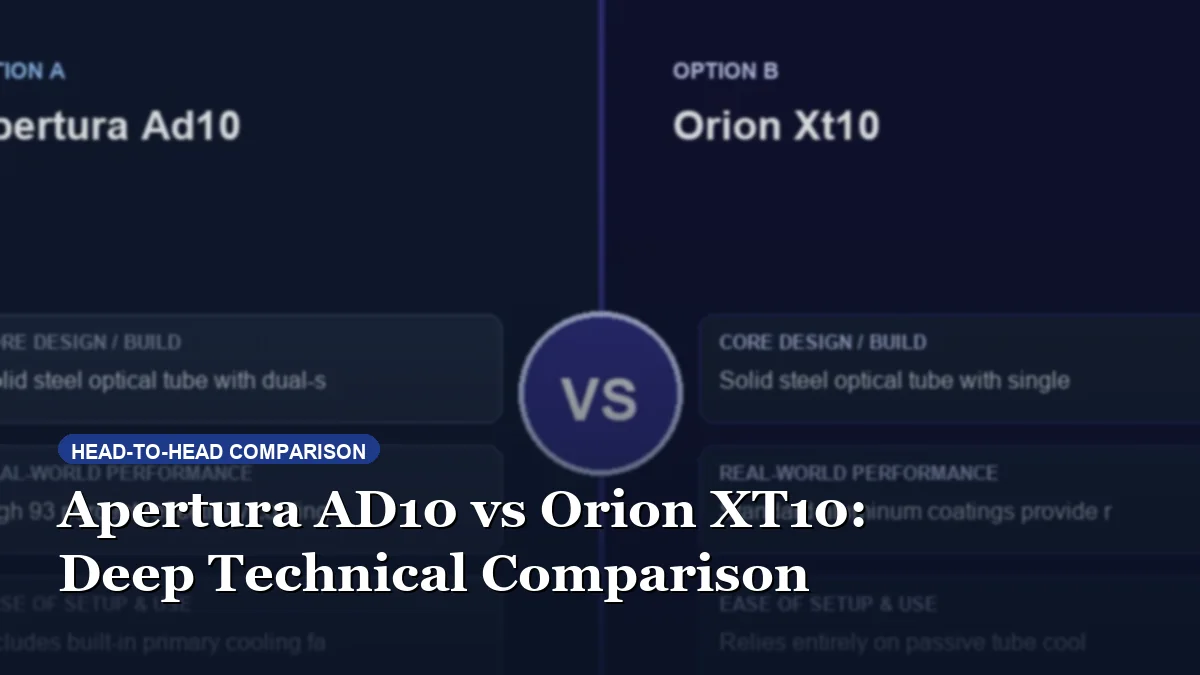
Choose the Apertura AD10 if you prioritize superior out-of-the-box accessories and active mirror cooling. Select the Orion XT10 if you prefer a streamlined, time-tested optical tube assembly with classic mechanical simplicity.
Compare all top models in our Best Telescope: Top Backyard Picks for Astronomy.
Side-by-Side Breakdown
| Criteria | Apertura Ad10 | Orion Xt10 | Edge |
|---|---|---|---|
| Core Design / Build | Solid steel optical tube with dual-speed Crayford focuser | Solid steel optical tube with single-speed Crayford focuser | Apertura Ad10 |
| Real-World Performance | High 93 percent reflectivity coatings maximize photon capture | Standard aluminum coatings provide reliable broadband views | Apertura Ad10 |
| Ease of Setup & Use | Includes built-in primary cooling fan for thermal management | Relies entirely on passive tube cooling and ambient airflow | Apertura Ad10 |
| Durability & Reliability | Sturdy particle board rocker box with tension adjustment knobs | Rugged base design with durable laminate exterior finishes | Tie |
| Efficiency / Operating Footprint | Large footprint requires stable ground and vehicle transport space | Similar massive base footprint demanding dedicated storage room | Tie |
| Maintenance Requirements | Standard collimation knobs require occasional optical alignment checks | Traditional collimation springs need routine manual tuning adjustments | Tie |
| Best Ideal Use Case | Deep-sky observers wanting premium stock eyepieces and finders | Purists seeking a straightforward optical tube and reliable mount | Apertura Ad10 |
Core Design and Engineering Differences
Both Dobsonians feature a ten-inch aperture parabolic primary mirror housed in a sturdy steel optical tube assembly. Thermal management and mechanical rigidity dictate how quickly these heavy instruments reach thermal equilibrium outdoors.
The Apertura incorporates an integrated cooling fan on the primary mirror cell. As outlined in our Orion SkyQuest XT10 review, competing models often rely on traditional passive cooling through open tube currents.
Structural integrity remains paramount when dealing with focal lengths exceeding one thousand millimeters. Both manufacturers utilize heavy-gauge rolled steel tubes to minimize flexure during zenith tracking and horizon sweeps.
- The Apertura utilizes a high reflectivity quartz overcoated primary mirror designed to maximize photon collection efficiency across faint nebulae and distant galaxies during dark-sky visual observing sessions.
- Orion equips their XT10 with standard aluminum protective coatings yielding reliable broadband reflectivity while maintaining robust scratch resistance against routine cleaning and environmental dust accumulation over time.
Optical Coatings and Glass Substrates
Mirror reflectivity ratings heavily influence overall light transmission efficiency during deep-sky observing sessions. Premium enhanced aluminum coatings on modern reflectors push light throughput figures higher than standard bare aluminum surfaces.
Substrate thermal expansion coefficients dictate how well the glass handles rapid temperature drops during winter nights. Both systems employ stable low-expansion borosilicate glass blanks to prevent severe optical figure distortion.
- Enhanced coatings deliver superior brightness across faint extended deep-sky objects.
- Borosilicate substrates minimize focal shift during cooling cycles.
Tube Assembly Rigidity and Venting
Maintaining collimation accuracy depends heavily on tube structural stiffness and cell design. Heavy-duty mirror cells prevent primary mirror sag when the telescope points toward low horizon targets.
Active ventilation drastically reduces the waiting period required for the primary mirror to match ambient outdoor temperatures. Passive cooling tubes often require an hour or more to settle down completely.
- Active fans clear boundary layer air currents near the mirror surface.
- Solid steel walls prevent stray light intrusion from nearby ground sources.
Real-World Optical Performance
Evaluating planetary contrast and deep-sky resolution requires examining optical figure smoothness. As noted in our Orion XT10 Plus review, ten-inch mirrors gather enough light to resolve globular clusters into individual pinpoint stars.
Collimation precision directly impacts high-magnification views of lunar craters and Saturn ring divisions. Using a laser collimator ensures both Newtonian reflectors operate at peak theoretical resolution limits.
Atmospheric seeing conditions often become the limiting factor rather than the optics themselves. On steady nights, these instruments reveal delicate spiral arm details in bright face-on galaxies.
- Parabolic figures eliminate spherical aberration at fast focal ratios.
- Large aperture diameters provide high resolving power for tight double stars.
Deep-Sky Contrast and Resolution
Faint fuzzies and emission nebulae benefit immensely from the massive light-gathering surface area of ten-inch mirrors. Dark adaptation and averted vision technique help extract subtle contrast details.
Observing from dark sky locations allows these telescopes to push past magnitude thirteen thresholds easily, revealing countless faint NGC catalog targets.
- Aperture advantage translates to brighter exit pupils at equivalent magnifications.
- Quality eyepieces preserve edge-to-edge sharpness across wide apparent fields.
Lunar and Planetary Sharpness
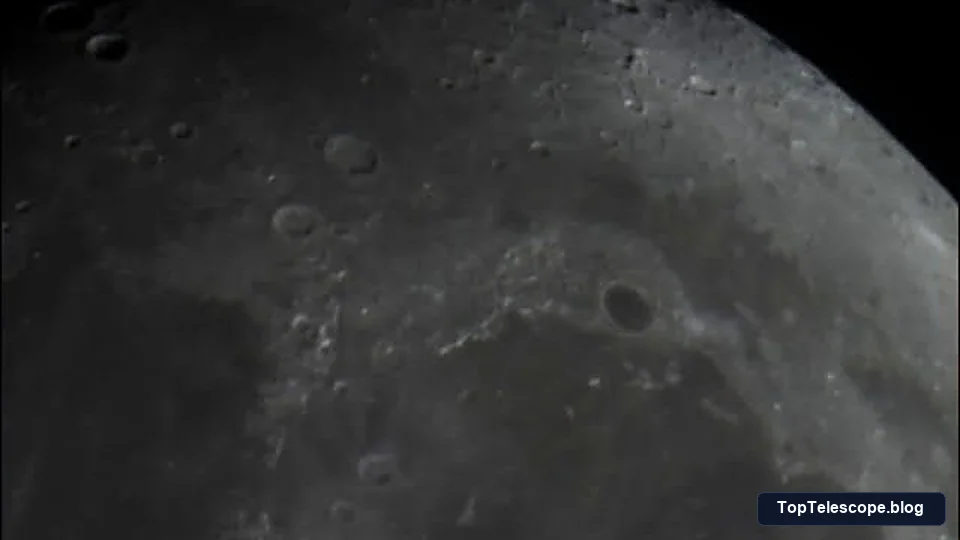
High contrast lunar observing requires smooth optical surfaces with minimal micro-roughness scattering light. Terminator views showcase sharp mountain shadows and intricate crater floor rilles.
Gas giant planets exhibit rich cloud belt structures, Great Red Spot details, and Jovian moon shadow transits when local atmospheric seeing remains calm and stable.
- Planetary filters enhance subtle color variations in Jovian cloud belts.
- High magnification capabilities demand sturdy mounting platforms to damp vibrations.
Mount Mechanics and Ergonomics
Dobsonian bases rely on simple altitude-azimuth mechanics to provide smooth manual tracking movements across the night sky. Particle board construction keeps manufacturing costs low while offering substantial weight.
Tension adjustment systems prevent the heavy optical tube assembly from slipping when swapping out bulky eyepieces. Our Apertura AD10 Dobsonian review highlights how proper balancing ensures effortless fingertip control during high power tracking.
Laminate exterior finishes protect the wooden base structures from morning dew and minor moisture exposure during extended field observation sessions under rural skies.
- Teflon bearing pads ensure smooth azimuth rotation without sticky stiction issues.
- Spring tension systems allow users to lock altitude positions securely.
Base Construction and Bearings
The rocker box design must support considerable weight without warping or flexing during transport. Quality materials and reinforced corner joints guarantee long-term mechanical stability.
Azimuth base rotation relies on low-friction bearing material sliding smoothly against durable melamine laminate surfaces for seamless manual slewing control.
- Melamine surfaces resist scratching from repeated base rotation cycles.
- Sturdy carrying handles facilitate moving the heavy base assembly outdoors.
Focuser Mechanics and Stability
Focusing mechanisms dictate how precisely you can dial in pinpoint star images at high magnifications. Dual-speed Crayford focusers offer fine adjustment knobs with a ten-to-one reduction ratio.
Single-speed focusers work adequately for low power scanning but require a delicate touch to achieve exact focus during high magnification planetary viewing sessions.
- Crayford designs eliminate image shift common in rack and pinion units.
- Compression rings secure heavy 2-inch eyepieces without marring barrel surfaces.
Maintenance, Efficiency and Longevity
Newtonian reflectors require periodic user maintenance to keep optical alignments accurate and mirror surfaces clean. Dust accumulation is inevitable, but frequent cleaning should be avoided to prevent coating wear.
Collimation bolts on both telescope models allow straightforward mirror tilt adjustments using simple hand tools or dedicated thumb screws. Maintaining alignment preserves crisp optical performance.
Storing optical tubes indoors in a temperature-controlled environment prevents internal condensation and mold growth on optical coatings over years of ownership.
- Primary mirror cleaning requires distilled water and mild photographic wetting agents.
- Secondary mirror spiders must remain centered to prevent vignetting issues.
Collimation Procedures and Stability
Laser collimators and Cheshire eyepieces simplify the optical alignment process before heading out for an evening observing session. Consistent mechanical tube design holds collimation well during transport.
Checking alignment after loading the telescope into a vehicle ensures optimal performance once you arrive at your designated dark sky observing site.
- Spring-loaded collimation screws simplify thumb adjustments in the dark.
- Secondary mirror holder alignment prevents off-axis optical aberrations.
Long-Term Storage and Care
Dust caps protect optical surfaces while the telescope rests indoors between astronomical observing runs. Keeping optical tubes capped vertically minimizes settling dust accumulation.
Moisture control using desiccant packs inside sealed storage covers helps prevent chemical degradation of mirror coatings in humid regional climates.
- Cover optical assemblies immediately after ending late night sessions.
- Inspect mechanical fasteners periodically to ensure no components loosen.
Accessories and Out-of-the-Box Value
Out-of-the-box equipment bundles heavily influence the initial value proposition for budget-conscious amateur astronomers. Comprehensive accessory packages save users substantial money on essential upgrades.
Finderscopes play a critical role in locating deep-sky targets quickly under dark skies. Optical finders and reflex sights offer distinct advantages depending on light pollution levels.
Eyepiece selection included with stock packages determines your starting magnification options for sweeping Milky Way star fields or inspecting lunar craters.
- Apertura includes a high quality 8x50 optical finderscope and two multi-coated eyepieces.
- Orion typically bundles standard basic finders and entry-level eyepieces requiring future upgrades.
Finderscopes and Sighting Aids
Straight-through optical finders match the orientation of Newtonian reflectors or require correct-image erecting prisms for intuitive navigation. Telrad reflex sights project reticle circles onto the night sky.
Combining a zero-power reflex sight with an optical finderscope creates an ideal dual-sighting system for locating faint Messier catalog objects rapidly.
- Illuminated reticles assist target centering against dark backgrounds.
- Quick-release brackets simplify disassembly during transport.
Eyepieces and Barlow Lenses
Wide-field eyepieces provide immersive viewing experiences by expanding the apparent field of view significantly. Quality glass elements reduce chromatic aberration and edge distortion.
Barlow lenses effectively double your eyepiece collection by halving focal lengths for high-power planetary and lunar observation sessions.
- Two-inch wide-field eyepieces offer expansive views of large star clusters.
- Multi-element designs correct field curvature across fast focal ratios.
Portability and Operating Footprint
Ten-inch Dobsonians represent substantial physical investments in size and weight for amateur astronomers. Transporting these large instruments requires careful vehicle packing and adequate storage space.
The optical tube assembly and wooden base are usually carried separately to make handling manageable for a single person during field setup routines.
Ground footprint requirements demand a relatively flat, stable surface outdoors to prevent rocking or base shifting during high magnification tracking procedures.
- Split tube designs do not apply here since both use solid ten-inch tubes.
- Carrying straps or balanced handles ease short-distance transport steps.
Transport and Vehicle Loading
Back seats and large trunk spaces accommodate ten-inch optical tubes comfortably when padded with blankets or secured in dedicated padded carrying cases.
Base sections ride flat on vehicle floors, providing a stable platform that prevents shifting during transit over bumpy rural roads.
- Padded transport bags protect exterior metal finishes from scratches.
- Securing gear prevents accidental impact damage during transit.
Field Footprint and Stability
Setting up on grass or dirt requires checking levelness to ensure smooth azimuth rotation without binding or uneven resistance.
Wind loading on large solid tube assemblies can introduce micro-vibrations, making sheltered observation spots highly desirable on breezy nights.
- Wide base footprints maximize physical stability on uneven ground.
- Wind shields or natural barriers reduce vibration interference.
Which Option Fits Your Setup
Selecting between these two stellar Dobsonians depends on whether you value immediate accessory value or proven legacy branding. Both instruments deliver breathtaking views of the night sky.
Evaluating your local storage capacity, transport vehicle size, and personal lifting strength helps ensure your chosen telescope sees frequent, enjoyable use.
Investing in proper collimation tools and comfortable seating rounds out an exceptional amateur astronomy setup tailored to your specific observing goals.
- Match your local light pollution levels and transport limits to your choice.
- Prioritize included accessories if you want to avoid immediate upgrade purchases.
Choosing the Apertura AD10
The Apertura stands out for observers wanting a complete package featuring a cooling fan and dual-speed focuser right out of the shipping boxes.
Our Apertura AD10 review details how enhanced mirror reflectivity coatings provide that extra edge in light transmission when hunting down elusive, faint deep-sky nebulae.
- Integrated cooling fans speed up thermal equilibrium significantly.
- Dual-speed focusers provide precise control at high magnifications.
Choosing the Orion XT10
The Orion appeals to astronomers who prefer a reliable, traditional optical tube backed by a trusted brand with extensive community support.
Straightforward mechanics make maintenance approachable for beginners learning the fundamentals of Newtonian telescope care and collimation.
- Robust mechanical heritage ensures reliable long-term field operation.
- Simple single-speed focusers are easy to service and maintain.
Frequently Asked Questions
Do these telescopes require heavy lifting during setup?
Yes, both models feature heavy components split between the optical tube and wooden base. Transporting them requires careful handling and manageable lifting strength.
What is the main advantage of the Apertura AD10 over the Orion XT10?
The Apertura includes a built-in primary cooling fan and enhanced reflectivity coatings. These features provide superior thermal management and brighter deep-sky images.
How often do these ten-inch Dobsonians need collimation?
Collimation checks are recommended before every major observing session, especially after vehicle transport. Routine alignment ensures crisp planetary and lunar views.
Can these Dobsonians be used for astrophotography?
They are primarily designed for visual astronomy due to manual alt-az mounts. Long-exposure deep-sky astrophotography requires equatorial tracking platforms.
What accessories should I buy first for these telescopes?
A laser collimator and a comfortable adjustable observing chair are essential. These additions improve alignment accuracy and overall viewing comfort.