Altazimuth vs Equatorial Mount: Definitive Technical Guide
Choosing the right telescope mount defines your astronomical workflow. Master the mechanics separating altazimuth simplicity from equatorial tracking precision.

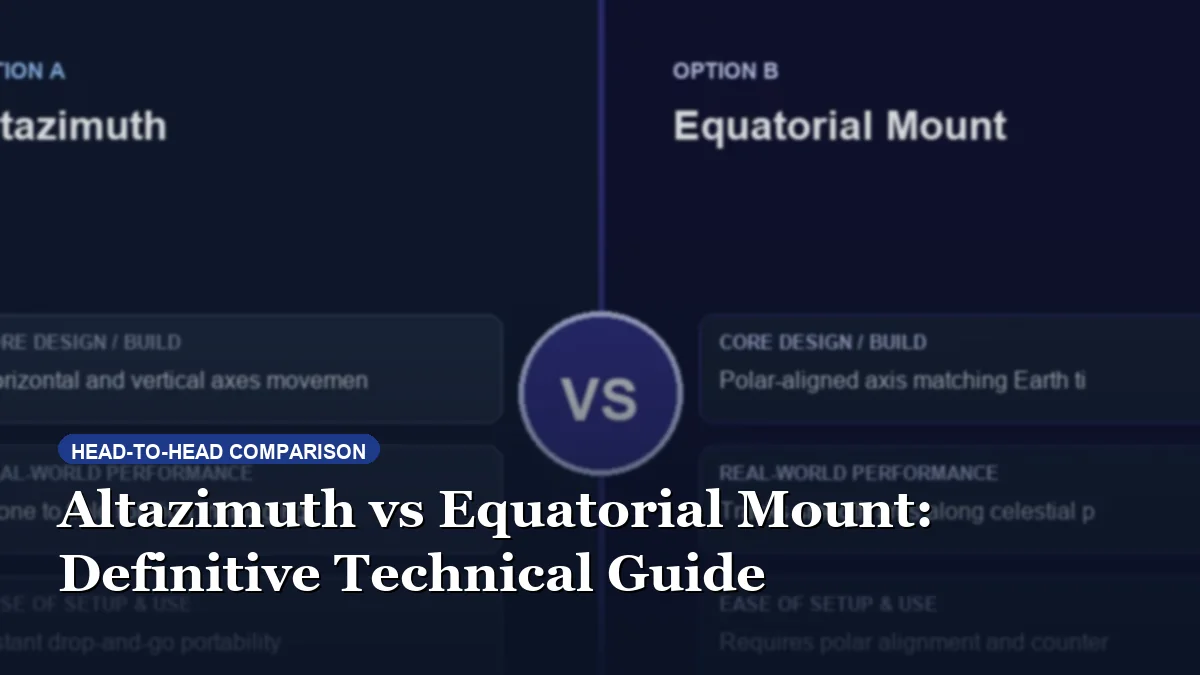
Choose altazimuth for rapid setup and intuitive terrestrial viewing. Select an equatorial mount if you demand effortless celestial tracking and long-exposure astrophotography without rotational field drift.
Compare all top models in our Best Telescope: Top Backyard Picks for Astronomy.
Side-by-Side Breakdown
| Criteria | Altazimuth | Equatorial Mount | Edge |
|---|---|---|---|
| Core Design / Build | Horizontal and vertical axes movement | Polar-aligned axis matching Earth tilt | Equatorial |
| Real-World Performance | Prone to field rotation in imaging | Tracks smooth arcs along celestial poles | Equatorial |
| Ease of Setup & Use | Instant drop-and-go portability | Requires polar alignment and counterweights | Altazimuth |
| Durability & Reliability | Fewer mechanical parts to fail | Complex gears and clutches demand care | Altazimuth |
| Efficiency / Operating Footprint | Compact footprint fits tight balconies | Wide tripod spread and heavy counterweights | Altazimuth |
| Maintenance Requirements | Minimal routine tension adjustments | Periodic worm gear tuning and greasing | Altazimuth |
| Best Ideal Use Case | Quick visual observing and nature study | Deep-sky astrophotography and research | Depends on Goal |
Core Design and Mechanical Engineering
The altazimuth system moves across simple horizontal and vertical axes. This design mimics standard photographic tripods, offering intuitive altitude movements that beginners master within minutes of field deployment.
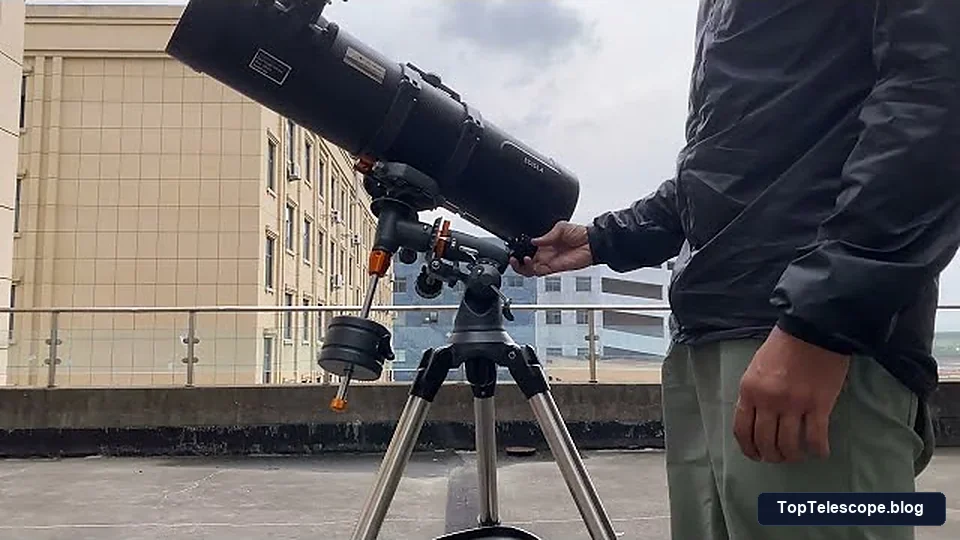
Conversely, choosing the best equatorial mount lets you tilt the primary axis to match Earth's rotational angle. This alignment allows a single slow-motion cable to follow stars perfectly.
Engineering tolerances dictate how smoothly these metal castings operate under load. High-end systems utilize brass worm gears to minimize backlash and ensure rock-solid stability during high-magnification viewing sessions.
Altazimuth mounts operate on horizontal and vertical axes, mirroring natural human movements. This simplified two-axis design reduces manufacturing complexity, resulting in lower structural weight and improved portability for amateur field astronomers.
Conversely, equatorial mounts tilt their primary polar axis to match Earth’s rotational plane. This inclined geometry requires heavy counterweight systems to balance offset optical tube assemblies, increasing the overall mechanical footprint considerably.
Internal gear tolerances dictate tracking smoothness across both mechanical architectures. Premium worm gear drives minimize periodic error, whereas simpler altazimuth setups often utilize slip clutches or friction bearings for rapid manual repositioning.
- Altazimuth relies on dual perpendicular orthogonal axes.
- Equatorial mounts require precise polar axis inclination.
- Gear meshing quality determines tracking backlash.
Axis Mechanics and Load Balance
Balancing payload weight remains critical for mechanical longevity. Altazimuth setups center weight directly over the tripod apex, whereas equatorial systems demand heavy counterweight shafts to offset optical tube torque.
Understanding torque distribution prevents premature wear on internal clutches and motor drives during extended astronomical observation runs.
- Center of gravity alignment prevents motor strain.
- Counterweights offset long optical tube assemblies.
Real-World Tracking and Optical Performance
Earth rotates on an inclined axis, causing stars to appear in curved overhead paths. Altazimuth mounts track these objects using diagonal stepping motions, which introduces noticeable field rotation over time.
Equatorial designs naturally compensate for this planetary rotation by tracking a single axis. This smooth motion prevents target drift and eliminates image rotation during extended photographic exposures.
Visual observers rarely notice altazimuth stepping artifacts at low magnifications. However, planetary imagers and deep-sky photographers require the uncompromised tracking accuracy provided by polar-aligned equatorial platforms.
Earth rotation causes celestial objects to drift in a curved, diagonal path across the night sky. Equatorial platforms effortlessly compensate for this motion using a single-axis motor running at sidereal rate.
Altazimuth configurations must adjust both altitude and azimuth simultaneously in non-linear steps. This creates noticeable field rotation artifacts during long-exposure astrophotography, making computerized derotators mandatory for serious deep-sky imaging projects.
Visual observers rarely notice altazimuth stepping anomalies at moderate magnifications. However, planetary imagers benefit immensely from equatorial tracking accuracy, which eliminates image blur and maintains consistent framing throughout extended video captures.
- Altazimuth motion creates stepwise diagonal staircases.
- Equatorial tracking follows smooth celestial arcs.
- Field rotation plagues long altazimuth camera exposures.
Astrophotography Tracking Demands
Long-exposure astrophotography punishes mechanical imperfections ruthlessly, making the best equatorial mount for astrophotography an essential upgrade. These platforms accept autoguiders easily, correcting minor periodic errors to keep stars sharp.
Attempting deep-sky imaging on standard altazimuth bases requires expensive derotator hardware to prevent star trails during multi-minute exposures.
- Autoguider integration is standard on equatorial drives.
- Field derotators add cost to altazimuth imaging setups.
Setup Speed and Field Ergonomics
Field accessibility often dictates how frequently an amateur astronomer observes the night sky. Altazimuth mounts provide unbeatable grab-and-go convenience, requiring zero alignment routines before starting observations.
Equatorial platforms demand physical alignment with celestial poles. This calibration step takes precious time, requiring clear views of specific reference stars or Polaris before tracking can begin.
Ergonomic layout also affects eyepiece positioning during meridian flips. Equatorial eyepieces can rotate into awkward neck-straining angles, whereas altazimuth designs maintain predictable viewing heights.
Rapid deployment favors altazimuth mounts due to their intuitive point-and-view operation style. Users simply place the tripod, level the base, and begin observing without complicated polar alignment routines in the field.
Equatorial systems demand careful latitude adjustments and physical sighting of celestial poles before operation commences. This multi-step calibration phase extends initial field assembly times significantly, requiring patience during cold evening setup sessions.
Eyepiece position ergonomics differ drastically during long observing marathons, even when using the best budget equatorial mount. Equatorial designs often place oculars at awkward viewing angles, whereas altazimuth forks maintain a more comfortable height for seated observers.
- Altazimuth enables instant backyard deployment.
- Polar alignment adds mandatory calibration overhead.
- Meridian flips require careful eyepiece clearance checks.
Transportability and Field Footprint
Traveling to dark-sky sites highlights weight and bulk differences. Altazimuth fork arms and single-arm Dobsonians pack quickly into vehicle trunks without loose counterweights.
Equatorial mounts separate into numerous heavy components, demanding careful assembly under dark conditions while managing separate counterweight bars and tripod legs.
- Single-piece altazimuth bases save assembly time.
- Equatorial tripods require multiple loose counterweights.
Alignment Procedures and Calibration Standards
Achieving accurate tracking requires mastering specific alignment methodologies. Altazimuth GoTo computers utilize multi-star alignment routines, calculating local time and coordinates to triangulate night sky targets.
Many advanced models, including the best equatorial mount under 1000, rely primarily on polar alignment scopes. Aligning this axis with the celestial pole ensures tracking motors turn steadily at the sidereal rate.
Modern computerized equatorial mounts incorporate software-assisted polar alignment routines, simplifying what was once a frustrating manual calibration hurdle for beginner backyard astronomers.
Accurate calibration underpins the pointing precision of computerized GoTo mounts. Altazimuth systems rely on multi-star alignment routines, calculating horizontal encoder offsets to achieve reliable target positioning across the night sky.
Equatorial mounts prioritize celestial pole alignment over complex software star modeling. Using a polar finderscope or drift method ensures the polar axis matches Earth's inclination, enabling seamless tracking accuracy over hours.
Environmental factors like thermal expansion and mechanical backlash degrade alignment integrity over time. Regular calibration checks and gear maintenance preserve pointing accuracy, preventing frustrating search errors during astronomical imaging sessions.
- Altazimuth systems use multi-star electronic plate solving.
- Equatorial mounts depend on precise polar axis pointing.
- Sidereal tracking rates match Earth rotational speed.
Software Assistance in Modern Mounts
Built-in alignment software bridges the gap between mechanical complexity and user friendliness. Hand controllers guide users through clear step-by-step calibration prompts.
Sensors and internal accelerometers reduce human error, ensuring reliable GoTo accuracy even when observing from partially obstructed urban backyards.
- Hand controllers automate star calibration.
- Sensors compensate for minor leveling errors.
Payload Capacity and Weight Distribution
Supporting heavy optical tubes safely requires robust mechanical chassis construction. Altazimuth forks distribute load symmetrically over both sides, handling short heavy scopes like Schmidt-Cassegrains effortlessly.
Equatorial designs cantilever weight out to one side, necessitating counterweights that match the optical tube mass to prevent tipping and excessive gear wear.
Rigidity directly influences image stability when focusing or battling outdoor wind gusts. Choosing a mount with a generous weight margin ensures crisp planetary views during breezy nights.
Mount stability directly depends on how effectively payload weight centers over the tripod legs. Altazimuth forks distribute equipment mass symmetrically, providing excellent structural rigidity without excessive counterweight loads straining the mount.
Equatorial mounts position telescopes off-center, creating cantilevered moments of force. To compensate safely, operators must attach heavy counterweights that often double the total transported mass required for field observations.
Exceeding manufacturer payload ratings introduces flexure and wind-vane vibrations that ruin high-magnification views. Choosing rigid aluminum or carbon-fiber tripods mitigates these resonance issues, ensuring a steady platform for sensitive optical tubes.
- Fork altazimuth designs offer balanced load handling.
- German equatorial mounts require matching counterweights.
- Rigid chassis construction minimizes wind vibration.
Optical Tube Compatibility
Long refractors exert high leverage forces on mounts, making sturdy equatorial piers mandatory for vibration damping. Short focal length reflectors pair wonderfully with lightweight altazimuth bases.
Matching your optical tube physical length to the mount geometry prevents unexpected clearance collisions with tripod legs during zenith observations.
- Refractors require high clearance equatorial piers.
- Short reflectors suit compact altazimuth tripods.
Maintenance Protocols and Longevity Factors
Mechanical longevity depends upon routine owner upkeep and environmental protection. Altazimuth mounts feature enclosed gearboxes that resist dust ingress and require very little seasonal maintenance.
Equatorial worm gears and external clutches demand periodic tension adjustments, cleaning, and fresh synthetic grease application to maintain silky smooth tracking action.
Storing optical equipment in climate-controlled environments prevents internal condensation and preserves electronic circuit boards against corrosive moisture damage over decades of service.
Mechanical longevity relies on routine lubrication of internal gears and thrust bearings. Equatorial worm drives require periodic backlash adjustment to maintain smooth meshing, preventing excessive gear wear during prolonged tracking operations.
Altazimuth mounts feature fewer exposed moving parts, lowering overall long-term maintenance requirements significantly. However, electronic encoder rings and internal clutches still need periodic inspection to prevent dust contamination and electrical faults outdoors.
Proper storage inside padded cases protects delicate tracking motors and optical encoders from moisture damage. Implementing these preventative care steps guarantees reliable mechanical performance across years of night sky exploration.
- Altazimuth designs feature simple low-maintenance housings.
- Equatorial gears need periodic greasing and tensioning.
- Proper indoor storage prevents electronic corrosion.
Servicing Gears and Clutches
Addressing gear backlash keeps manual slow-motion controls crisp and responsive. Owners can adjust meshing tolerances using basic hex wrenches found in standard toolkit sets.
Keeping clutch surfaces clean ensures locking mechanisms grip securely without slipping under heavy imaging payloads.
- Backlash adjustments restore crisp manual control.
- Clutch maintenance prevents unexpected payload slips.
Frequently Asked Questions
Can I do astrophotography with an altazimuth mount?
Yes, but you are limited to short planetary exposures due to field rotation. Long deep-sky imaging requires an equatorial wedge or dedicated derotator.
Why do equatorial mounts need heavy counterweights?
Counterweights balance the cantilevered weight of the optical tube along the polar axis. This balance ensures smooth motor tracking and protects internal gears from excessive strain.
Is polar alignment difficult for beginners?
Traditional polar alignment takes practice, but modern computerized mounts feature guided software routines. These tools simplify the calibration process significantly for new astronomers.
Which mount type is best for quick grab-and-go sessions?
Altazimuth mounts offer the fastest setup since they require zero polar alignment. You simply place the tripod down and begin observing immediately.
Do altazimuth mounts support heavy telescopes?
Dual-arm altazimuth and Dobsonian bases support large optical tubes exceptionally well. They distribute weight evenly over the center of the tripod.