Celestron NexStar 6SE vs 8SE: Technical Comparison Guide
Choosing between these popular Schmidt-Cassegrain telescopes involves balancing aperture against physical portability. This guide details optical physics, mechanical builds, and practical ergonomics.

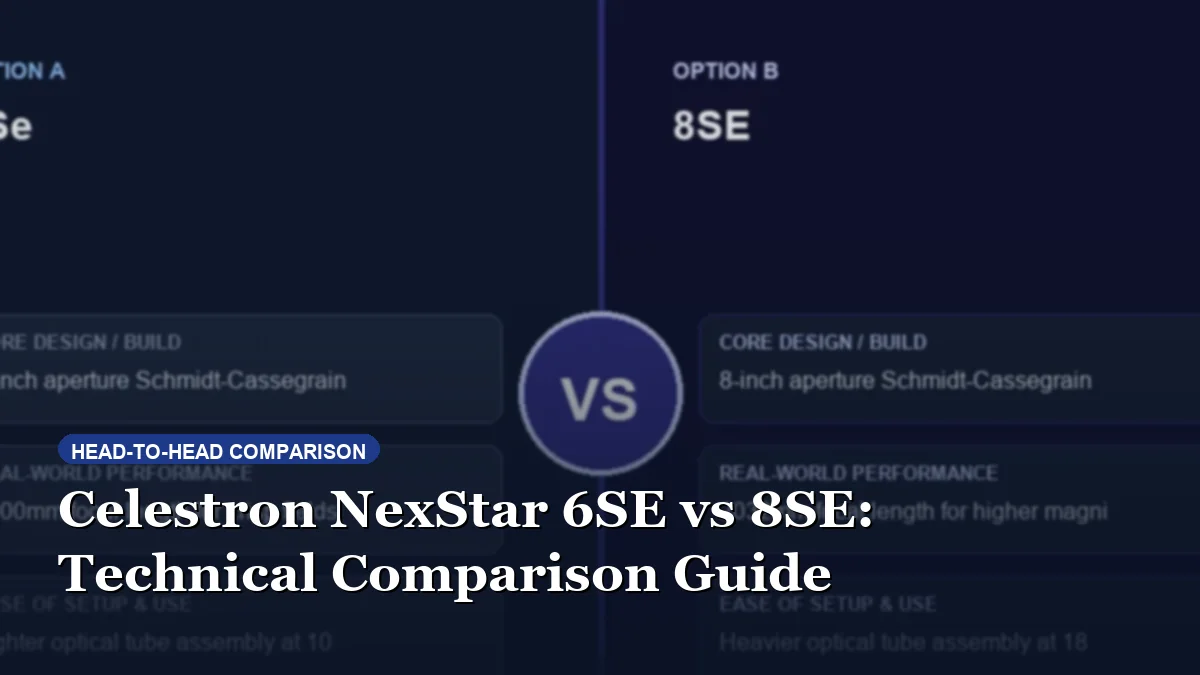
Choose the 6SE for superior portability and rapid backyard setup. Opt for the 8SE for maximum light-gathering when resolving faint deep-sky nebulae and planetary details.
Compare all top models in our Best Telescope: Top Backyard Picks for Astronomy.
Side-by-Side Breakdown
| Criteria | 6Se | 8SE | Edge |
|---|---|---|---|
| Core Design / Build | 6-inch aperture Schmidt-Cassegrain | 8-inch aperture Schmidt-Cassegrain | 8SE |
| Real-World Performance | 1500mm focal length for crisp fields | 2032mm focal length for higher magnification | 8SE |
| Ease of Setup & Use | Lighter optical tube assembly at 10 lbs | Heavier optical tube assembly at 18 lbs | 6Se |
| Durability & Reliability | Cast aluminum fork arm and steel tripod | Cast aluminum fork arm and steel tripod | Tie |
| Efficiency / Operating Footprint | Lower battery draw with identical electronics | Standard 12V power requirement with motors | 6Se |
| Maintenance Requirements | Standard corrector plate cleaning and collimation | Standard corrector plate cleaning and collimation | Tie |
| Best Ideal Use Case | Mobile backyard astronomy and quick lunar views | Advanced planetary imaging and deep-sky observation | 8SE |
Core Optical Engineering Differences
Optical design dictates how these Schmidt-Cassegrain systems manipulate light paths. The primary mirror diameter determines your overall light-gathering capacity during standard nighttime observation sessions.
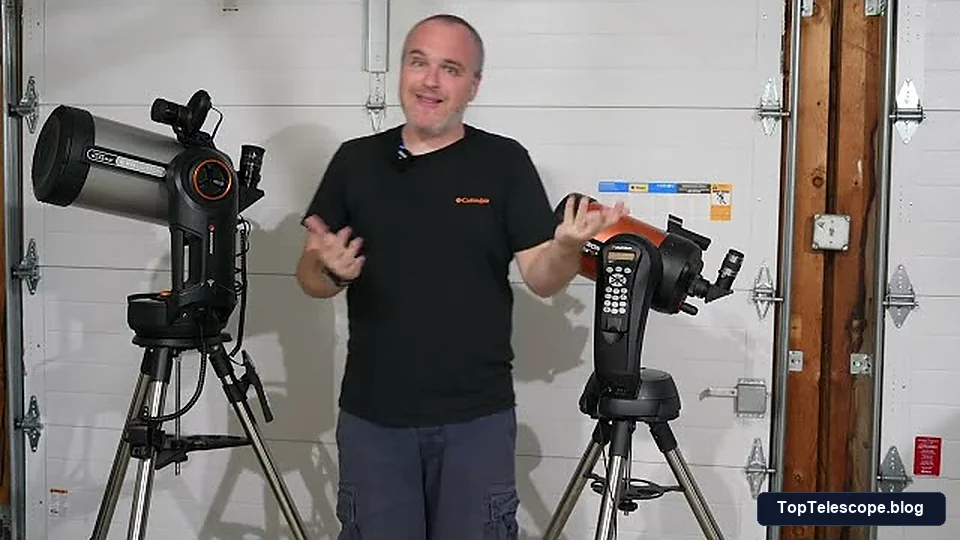
Internal baffling and correctors reduce chromatic aberration effectively across both models. However, the larger aperture shifts resolving thresholds significantly for advanced visual astronomy enthusiasts.
The Celestron 6SE features a 150mm aperture with an f/10 focal ratio, yielding a 1500mm focal length. This configuration provides sharp, diffraction-limited optics well-suited for moderate lunar and planetary observing sessions.
Stepping up, the Celestron 8SE utilizes a larger 203mm aperture while maintaining the same f/10 optical system. Read our celestron nexstar 8se review to evaluate deep-sky light gathering capabilities.
- Primary mirror diameters measure 150mm versus 203mm respectively.
- StarBright XLT coatings maximize photon transmission efficiently.
- Focal ratios sit at f/10 for precise planetary imaging.
Aperture Physics and Resolution Limits
Physics dictates that larger apertures resolve tighter double stars and fainter nebulae. Dawes limit calculations favor the larger mirror for sharp contrast.
You will notice brighter stellar diffraction patterns when viewing high-contrast planetary targets through the upgraded optical tube.
- Theoretical resolving power increases by roughly thirty percent.
- Image scale changes proportionally with the longer focal length.
Mechanical Build and Mounting Systems
Single-fork arm alt-azimuth mounts support both optical tubes using cast aluminum housings. Steel tripod legs provide structural rigidity during high-power focusing tasks.
Rigid steel spreader plates lock the tripod legs securely to suppress wind vibrations during long-exposure imaging runs.
Both telescopes utilize a single-fork arm design housing internal azimuth motors. Learn more inside our celestron nexstar 6se review regarding mechanical payload capacities and tracking accuracy.
Steel tripod legs provide a rigid foundation for observation. However, the 8SE tripod requires careful leveling and optional vibration suppression pads to dampen settling times caused by the heavier optical tube assembly.
- Mount base houses the internal computer drive system.
- Quick-release clamp mechanisms simplify field assembly greatly.
- Integrated leveling bubbles assist with initial alignment.
Chassis Weight and Structural Tolerances
Total payload weight directly affects motor longevity and tracking accuracy over extended observing sessions. Heavier loads demand precise balancing.
Gear tolerances inside the worm drives remain identical, but inertia loads differ between the two configurations.
- Tripod weight matches across both product packages.
- Fork arm stiffness accommodates minor center-of-gravity shifts.
Real-World Planetary Performance
Planetary observers require high magnification and exceptional contrast to resolve cloud bands on Jupiter and rings around Saturn. Seeing conditions often limit performance.
The longer focal length of the larger model yields higher native magnification using standard eyepiece selections.
Planetary observers benefit immensely from aperture scaling. The 8SE resolves finer details on Jupiter and Saturn because its larger primary mirror supports higher useful magnification limits under stable atmospheric seeing conditions.
Meanwhile, the 6SE thermal acclimatization occurs faster due to smaller glass mass. Consult our celestron 6se review for comprehensive cooling times and planetary performance tests.
- Atmospheric turbulence affects both apertures equally during bad seeing.
- Eyepiece selection dictates final exit pupil dimensions.
Magnification Thresholds and Seeing Conditions
Pushing magnification beyond two hundred power requires stable atmospheric conditions and perfect thermal acclimatization.
Cooling fans or passive thermal venting helps equalize internal tube temperatures before critical planetary viewing begins.
- Maximum useful magnification scales with aperture diameter.
- Barlow lenses integrate smoothly with standard diagonal setups.
Deep-Sky Object Resolution and Contrast
Faint fuzzies and distant galaxies demand maximum photons to stimulate human retinal cells or digital sensors effectively. Larger mirrors collect significantly more light.
Surface brightness increases proportionally, revealing subtle spiral arm details in Messier catalog targets.
Faint fuzzies demand light-gathering power above all else. The 8SE reveals fainter stars inside globular clusters and exposes subtle spiral structure in intermediate galaxies that remain hidden in smaller aperture instruments.
Contrast transmission relies heavily on effective baffling and internal tube blackening. Both telescopes deliver dark backgrounds, but the larger 8SE aperture punches through light pollution more effectively for nebula filter usage.
- Globular clusters resolve into individual stars more easily.
- Emission nebulae respond well to narrow-band filter additions.
Astrophotography Potential and Tracking
Alt-azimuth tracking introduces field rotation during long exposures, limiting deep-sky astrophotography unless an equatorial wedge is utilized.
Guiding accuracy depends heavily on balanced payloads and proper alignment routines executed prior to imaging.
- Wedge accessories convert the mount for equatorial tracking.
- Camera payload limits restrict heavy DSLR usage.
Setup Ergonomics and Field Portability
Transporting gear to dark sky sites tests your patience if component weights exceed comfortable lifting thresholds for single users.
Compact dimensions allow the smaller configuration to fit easily into standard vehicle backseats without disassembling accessories.
Field transport involves balancing weight against optical performance. The 6SE optical tube weighs roughly ten pounds, making overhead attachment straightforward for single-person setup routines during remote dark-site expeditions.
Conversely, the 8SE requires careful lifting since the heavier tube demands precision when mounting. Our nexstar 8se field review covers safe handling procedures and transport ergonomics.
- Optical tube weight differs by nearly eight pounds.
- Carrying handles simplify mounting the tube onto the fork.
Field Assembly and Teardown Speed
Quick deployment encourages frequent use, whereas cumbersome equipment often stays stored inside closets during weeknights.
Cable management prevents snagging during automated GoTo slew movements across the night sky.
- Hand controller pockets keep accessories organized.
- Power cords require secure routing to avoid tangles.
Power Management and Electronic Efficiency
Internal computer hand controllers draw steady electrical current from external battery packs or household power adapters during operation.
Voltage drops can cause erratic hand controller behavior or motor stalls if power supplies are inadequate.
Computerized GoTo systems consume significant direct current. Internal battery compartments hold eight AA cells, but cold weather rapidly drains alkaline batteries, necessitating external rechargeable lithium power tanks for reliable tracking.
Voltage drops can cause erratic hand controller behavior and alignment loss. Using a regulated twelve-volt supply ensures consistent motor torque and prevents frustrating computer reboots during long imaging sessions.
- Standard battery packs hold eight AA alkaline cells.
- Lithium power banks provide longer field operating times.
Battery Drain and Auxiliary Power Sources
Cold weather drastically reduces internal battery efficiency, necessitating external tank connections during winter observation nights.
AC adapters suit permanent backyard observatory sheds equipped with standard electrical outlets.
- Current draw spikes during fast GoTo slew operations.
- Car cigarette lighter adapters offer mobile power options.
Long-Term Maintenance and Collimation
Schmidt-Cassegrain optics rarely require collimation adjustments if handled with reasonable care during transit and storage routines.
Dust accumulation on the corrector plate is normal and requires infrequent cleaning using specialized optical solutions.
Schmidt-Cassegrain optics rarely require complete alignment adjustments if handled carefully. However, transporting telescopes over rough roads can shift the secondary mirror, requiring precise primary mirror cell adjustments using standard allen wrenches.
Dust accumulation on the corrector plate is inevitable over time. Owners should clean optics sparingly using professional optical microfiber cloths and approved cleaning solutions to protect the delicate anti-reflective coatings.
- Secondary mirror screws allow precise optical alignment.
- Dust covers protect internal elements between viewing sessions.
Optic Cleaning Protocols and Storage
Never touch optical glass surfaces directly with bare fingers to avoid transferring natural skin oils that attract dust particles.
Store optical tubes in padded cases with desiccant packs to prevent internal mold growth during humid summer months.
- Microfiber cloths prevent scratching delicate coatings.
- Compressed air safely removes loose surface debris.
Frequently Asked Questions
Can I use these telescopes for serious deep-sky astrophotography?
Both platforms feature alt-azimuth fork mounts that introduce field rotation during long exposures, which restricts them primarily to planetary imaging unless paired with an equatorial wedge. Serious deep-sky imagers typically prefer dedicated equatorial mounts for tracking accuracy.
How difficult is it to align the GoTo computer system?
SkyAlign technology makes alignment straightforward by letting you center any three bright celestial objects without needing to know their names. The computer calculates your exact position and time automatically once validation completes successfully.
Do I need to purchase a heavy-duty power tank immediately?
Internal battery holders accommodate eight standard AA cells for initial field sessions, but cold weather drains them rapidly during long nights. Upgrading to an external rechargeable lithium power tank ensures stable voltage delivery throughout extended viewing marathons.
What is the primary difference in optical performance between models?
The larger mirror collects significantly more light and resolves tighter details on planets and distant galaxies due to its increased diameter. However, both systems share identical electronic computer systems and optical coating technologies.
Are these optical tube assemblies compatible with other mounts?
Vixen-style dovetail rails attached to the bottom of each optical tube allow mounting onto alternative equatorial or alt-azimuth systems. This versatility lets advanced users upgrade their tracking platforms later without replacing the primary optics.