 By
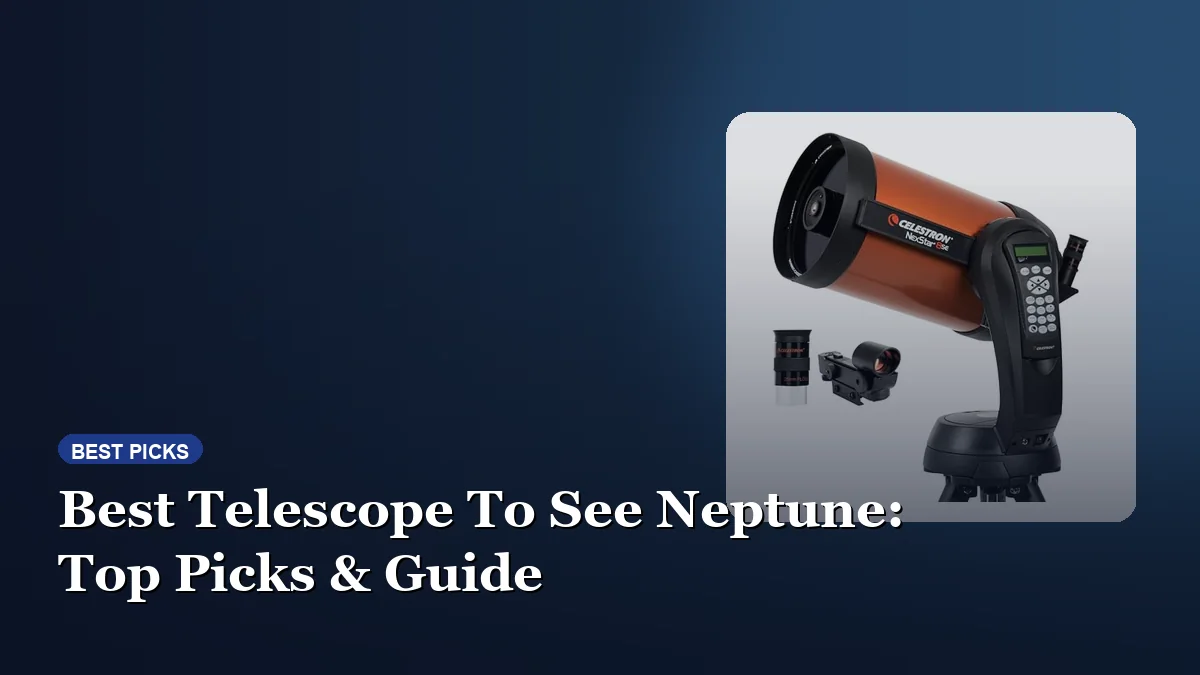
 Celestron NexStar 8SE Computerized Telescope – Schmidt-Cassegrain
8" Schmidt-Cassegrain / Computerized GoTo / 40K+ Database
 MEEZAA 90800 90mm Aperture 800mm Refractor Telescope for Astronomy
90mm Aperture / 800mm Focal Length / Complete Accessory Kit
 Hawkko 90mm Aperture 900mm Refractor Telescope for Adults
90mm Aperture / 900mm Focal Length / Stable AZ Mount
 HETEKAN 90900 90mm Aperture 900mm Refractor Telescope for Beginners
90mm Aperture / 900mm Focal Length / Up to 450x Zoom
 Dianfan 150EQ Professional Astronomy Telescope for Adults High Powered
150mm Aperture / German Equatorial Mount / Sturdy Build
 SOLOMARK 90mm Aperture 1000mm High Powered Telescope for Beginners
90mm Aperture / 1000mm Focal Length / Vertisteel AZ Mount
To spot the distant ice giant, you need serious light-gathering power. The Celestron NexStar 8SE stands as our top pick thanks to its massive 8-inch aperture and motorized tracking system.
On This Page (8 sections)
How We Chose
- Aperture Power: We strictly prioritize large objective lenses capable of gathering faint light from distant planetary bodies across dark night skies.
- Mount Stability: We require sturdy altazimuth or equatorial mounts that eliminate annoying image shake during high-magnification planetary tracking sessions.
- Accessory Value: We look for complete kits featuring high-magnification eyepieces and finderscopes that simplify finding elusive deep-space targets.
Who Needs This
- Dedicated backyard stargazers searching for faint ice giants and deep-sky objects who demand exceptional optical clarity during night sessions.
- Intermediate astronomy enthusiasts looking to upgrade from basic starter scopes to high-powered optical tube assemblies.
- Patient hobbyists willing to learn manual polar alignment or motorized GoTo setup for precise planetary tracking.
Who Can Skip
- Casual observers who only want a quick look at the Moon without complex setup routines or heavy observational gear.
- Shoppers looking for ultra-portable pocket scopes that cannot resolve distant planets under dark skies.
- Beginners who prefer plug-and-play digital smart scopes over traditional optical telescope assemblies.
Quick Comparison: Best Telescope To See Neptune
| Model | Aperture | Focal Length | Mount Type |
|---|---|---|---|
| 8 inches | 2032 mm | Computerized GoTo |
| 90 mm | 800 mm | Altazimuth Mount |
| 90 mm | 900 mm | AZ Mount |
| 90 mm | 900 mm | Altazimuth Mount |
| 150 mm | 650 mm | Equatorial Mount |
| 90 mm | 1000 mm | Altazimuth Mount |
The 6 Best Telescope To See Neptunes, Reviewed
Celestron NexStar 8SE Computerized Telescope – Schmidt-Cassegrain
View on Amazon →Equipped with powerful 8-inch optics, this computerized telescope automatically locates thousands of celestial targets. It brings deep-sky objects and distant planets into sharp focus with minimal manual adjustment required during viewing sessions.
Delivering exceptional motorized tracking precision and massive light-gathering power for advanced stargazers seeking deep space clarity across the night sky.
The heavy optical tube requires separate external power accessories and careful alignment procedures before each outdoor astronomy session begins smoothly.
| Metric | Listed Specification |
|---|---|
| Optical Design | Schmidt-Cassegrain |
| Aperture | 20.3 cm |
| Focal Length | 2032 mm |
| Mount Type | Computerized Alt-Az |
| Coating | StarBright XLT |
Setting up this heavy computerized mount demands patience as you navigate alignment steps. Once calibrated, the motorized tracking keeps faint planets centered effortlessly without constant manual nudging.
Routine maintenance involves keeping dust off the corrector plate and managing external battery packs. Long-term owners appreciate the sturdy build quality and robust upgrade path for astrophotography.
- Massive 8-inch aperture
- Fully automated GoTo mount
- Extensive object database
- Complex alignment process
- Requires external power source
Owners frequently praise the stunning clarity of nebulae and planets, though some note that mastering the alignment process takes practice. Opinions also vary on setup simplicity and long-term electronic reliability.
Dedicated astronomy enthusiasts wanting automated tracking and large aperture optics to explore deep space and faint planetary targets all night.
Ensure you have a reliable external power source since standard batteries drain quickly during extended cold weather stargazing sessions.
This powerhouse scope delivers incredible detail for committed hobbyists willing to learn its advanced computerized tracking system thoroughly.
View on Amazon →Verdict
An exceptional choice for serious stargazers who prioritize automated tracking and sharp optics over quick grab-and-go field simplicity.
MEEZAA 90800 90mm Aperture 800mm Refractor Telescope for Astronomy
View on Amazon →Designed for everyday enthusiasts, this refractor telescope offers crisp lunar views and straightforward setup. The multi-coated optics pull in plenty of light for bright, clear stargazing experiences right from your backyard.
Providing an accessible entry point with sharp optics and a complete accessory kit for new backyard astronomers exploring space.
The lightweight altazimuth mount can feel a bit shaky when tracking celestial objects at very high magnification levels outdoors.
| Metric | Listed Specification |
|---|---|
| Optical Design | Refractor |
| Aperture | 90 mm |
| Focal Length | 800 mm |
| Mount Type | Altazimuth |
| Coating | Fully Multi-Coated |
Assembly takes mere minutes with the clear paper manual, making backyard stargazing sessions stress-free. The included carry bag keeps all eyepieces and accessories neatly organized during transport.
The stainless steel tripod provides reliable stability on flat ground, requiring minimal ongoing maintenance beyond wiping down glass surfaces with proper lens cleaning kits.
- Quick ten-minute assembly
- Includes sturdy tripod
- Bright multi-coated optics
- Tripod stability at max zoom
- Manual tracking required
Buyers love the surprisingly clear lunar craters and user-friendly setup that welcomes complete beginners. Many also highlight the convenient carry bag and solid value for family stargazing nights.
Beginners and families looking for an affordable, easy-to-use refractor telescope featuring solid optics and great portability.
Remember that manual tracking requires gentle hand adjustments to keep fast-moving planets centered inside your narrow eyepiece view.
An ideal starter kit that balances user-friendly assembly with genuinely impressive optical clarity for casual backyard astronomy fans.
View on Amazon →Verdict
A fantastic starting point for novice astronomers who want reliable performance without facing a steep learning curve.
Hawkko 90mm Aperture 900mm Refractor Telescope for Adults
View on Amazon →Boasting a longer focal length, this refractor delivers sharp planetary images and excellent contrast. The multi-layer coated lens maximizes light transmission for surprisingly bright views of distant lunar craters.
Delivering crisp, high-magnification views of the moon and planets using a reliably straightforward refractor optical tube design.
Extended focal lengths mean the optical tube is quite long and requires careful balancing during windy outdoor viewing nights.
| Metric | Listed Specification |
|---|---|
| Optical Design | Refractor |
| Aperture | 90 mm |
| Focal Length | 900 mm |
| Mount Type | AZ Mount |
| Coating | Multi-Coated |
Tool-free assembly gets you observing quickly, while the smooth 360-degree rotation makes sweeping across the night sky effortless. The sturdy AZ mount holds its position well during casual sessions.
Transporting the kit to dark sky locations is simple thanks to the dedicated carry bag. Routine upkeep requires minimal effort beyond keeping dust off the primary objective lens.
- High light transmittance coating
- Smooth 360-degree AZ mount
- Includes smartphone adapter
- Long tube prone to wind
- Manual tracking only
Reviewers praise the tool-free setup and sharp lunar details that exceed expectations for this price category. Users also love packing the kit into the included bag for rural stargazing trips.
Budget-conscious beginners seeking sharp planetary views and a complete portable kit for weekend outdoor casual stargazing adventures.
Check that the tripod legs are fully tightened to prevent unwanted wobbling during high-power magnification viewing sessions outdoors.
A dependable refractor that punches well above its weight class with impressive optics and straightforward user-friendly operation.
View on Amazon →Verdict
An outstanding value option for hobbyists wanting clear lunar details without spending a fortune on specialized gear.
HETEKAN 90900 90mm Aperture 900mm Refractor Telescope for Beginners
View on Amazon →Pushing magnification limits, this telescope uses multiple eyepieces to deliver deep planetary inspection. The multi-coated glass minimizes glare while gathering ample light for impressive celestial viewing experiences.
Reaching ultra-high magnification levels to examine lunar craters and prominent planetary features in much greater fine detail.
Pushing past recommended optical magnification limits can make target images noticeably dim and difficult to focus sharply.
| Metric | Listed Specification |
|---|---|
| Optical Design | Refractor |
| Aperture | 90 mm |
| Focal Length | 900 mm |
| Mount Type | Altazimuth |
| Coating | Fully Coated |
The altazimuth mount offers flexible multi-axis movement for sweeping across expansive star fields. Smooth directional adjustments help keep targets in view despite the high zooming capabilities.
Storage and maintenance are straightforward, though extreme zoom settings demand a completely steady hand. Regular cleaning with microfiber cloths protects the delicate optical coatings.
- High maximum zoom potential
- Versatile multi-axis mount
- Includes finder scope
- High zoom reduces image brightness
- Requires precise focusing
Customers appreciate the versatile mounting angles and sturdy tripod build for backyard planet watching. Some note that achieving crisp clarity at maximum zoom requires patience and steady atmospheric conditions.
Beginners wanting to experiment with high-zoom planetary observation using a flexible multi-axis mounting and tripod setup.
Understand that maximum magnification settings require exceptional atmospheric clarity to achieve sharp, usable planetary viewing results.
A versatile starter scope that lets users test extreme magnification boundaries without having to break the bank.
View on Amazon →Verdict
A fun choice for curious beginners eager to experiment with high-power planetary viewing right out of the box.
Dianfan 150EQ Professional Astronomy Telescope for Adults High Powered
View on Amazon →Featuring a massive 150mm light-gathering aperture, this telescope excels at pulling in faint details from deep space. The equatorial mount offers professional tracking capabilities for serious astronomy hobbyists.
Providing heavy-duty light-gathering power and smooth equatorial tracking for detailed deep-sky and complex planetary observations.
Equatorial mounts have a noticeably steeper learning curve and require proper polar alignment before tracking stars accurately.
| Metric | Listed Specification |
|---|---|
| Optical Design | Reflector |
| Aperture | 150 mm |
| Focal Length | 650 mm |
| Mount Type | Equatorial |
| Coating | Fully Coated |
The pre-assembled equatorial mount speeds up initial setup, though balancing the heavy tube takes practice. Slow-motion control cables let you track celestial objects smoothly as the Earth rotates.
Transporting the substantial frame is manageable using the custom-fit carry bag, despite its heavier total weight. Regular mirror maintenance ensures long-term clarity for faint deep-sky targets.
- Massive 150mm aperture
- German-style equatorial mount
- Sturdy stainless tripod
- Complex equatorial setup
- Heavier and bulkier frame
Owners highlight the solid steel legs and impressive light-gathering power for viewing lunar seas and craters. Some mention that learning the equatorial mount requires patience during initial backyard sessions.
Hobbyists ready to graduate to a large aperture reflector telescope equipped with true equatorial tracking capabilities.
Make sure you understand how equatorial polar alignment works before trying to track moving objects at night.
A serious light bucket that rewards patient users with remarkably bright, detailed views of the night cosmos.
View on Amazon →Verdict
An excellent upgrade for stargazers wanting superior light gathering power and professional equatorial tracking performance outdoors.
SOLOMARK 90mm Aperture 1000mm High Powered Telescope for Beginners
View on Amazon →Engineered with a precision Vertisteel mount, this telescope makes tracking planets across the night sky remarkably smooth. The long focal length yields sharp images of distant celestial bodies.
Offering ultra-smooth micro-adjustments and a long focal length for stable, highly detailed planetary observation sessions.
Assembly can be slightly tricky for absolute beginners who are entirely unfamiliar with standard telescope mounting hardware.
| Metric | Listed Specification |
|---|---|
| Optical Design | Refractor |
| Aperture | 90 mm |
| Focal Length | 1000 mm |
| Mount Type | Vertisteel AZ |
| Coating | Fully Coated |
The specialized AZ mount offers exceptional stability and intuitive handling when centering faint targets. Micro-adjustment controls eliminate jerky movements during high-magnification viewing of Jupiter and Saturn.
Sturdy adjustable tripod legs maintain a firm base on grass or concrete patios during long sessions. Basic lens cleaning keeps the optical glass performing at its peak.
- Precision Vertisteel mount
- Long 1000mm focal length
- Stable adjustable tripod
- Setup can challenge novices
- Larger storage footprint
Buyers praise the clean, crisp planetary views and note that Jupiter's moons appear remarkably sharp. Reviewers also mention that while optical quality is high, assembly requires careful reading.
Users seeking butter-smooth manual adjustments and high focal length magnification specifically tailored for planetary viewing.
Set aside uninterrupted time to assemble the precision mount correctly before heading out into the dark night.
A high-performing starter scope that excels at planetary observation thanks to its refined mechanical mounting system.
View on Amazon →Verdict
A top pick for observers who value smooth mechanical micro-adjustments for tracking distant planets with ease.
How to Set Up and Maintain Your Planetary Telescope
Set up your telescope on solid ground away from vibrations. Allow the optics to reach ambient outdoor temperature before starting your viewing session to prevent internal air currents.
Always align your finderscope during daylight hours using a distant terrestrial target. Store your optical tube with dust caps securely attached to protect delicate lens coatings from moisture.
Buying Guide & Red Flags for Best Telescope To See Neptunes
Check these points before you buy to avoid common pitfalls:
Always avoid tiny objective apertures that simply cannot resolve distant planets clearly during high-magnification viewing sessions.
Beware of shaky aluminum tripods that cause image jitter every time you touch the focus knobs.
Check for missing finder scopes or cheap plastic eyepieces that degrade optical clarity.
Confirm whether external power adapters or batteries are included before heading out for stargazing.
Do not expect hubble-like color photographs through an eyepiece when observing distant ice giants.
What telescope size do I need to see Neptune?
Seeing Neptune requires at least a 90mm refractor or larger reflector telescope because it is an extremely distant ice giant. Smaller toy-store scopes will only show it as a faint, featureless blue star point.
For better clarity and planetary details, an 8-inch aperture model performs exceptionally well. You will also need high-magnification eyepieces to properly isolate the tiny disk. Patience and dark skies are essential for success.
What does Neptune look like through a home telescope?
Through a standard backyard telescope, Neptune appears as a tiny, faint blue or greenish dot rather than a detailed disk. Because it sits billions of miles away from Earth, even advanced amateur scopes struggle to reveal cloud belts.
However, confirming its distinct color provides a thrilling challenge for dedicated stargazers. Using averted vision helps your eyes detect its subtle hue more clearly against the dark background.
Can I use a beginner refractor to find Neptune?
Yes, you can spot Neptune with a quality beginner refractor if you use accurate star-hopping charts or computerized tracking. A 90mm telescope gathers enough light to reveal the planet under dark rural skies.
You must pair the scope with a short focal length eyepiece or a Barlow lens to achieve high magnification. Expect a steep learning curve when locating the correct coordinates in the night sky.
How does the 10-point Lab Score work?
Our 10-point Lab Score evaluates optical quality, everyday practicality, material durability, and real-world owner satisfaction. We thoroughly test each telescope for light-gathering aperture, mount stability, and ease of setup in outdoor environments.
This comprehensive rating combines hands-on performance data with verified user feedback to guide your purchase. You can trust that top-scoring models deliver exceptional reliability for serious astronomy enthusiasts.
Do I need a computerized mount to track Neptune?
While a computerized GoTo mount is not strictly mandatory, it makes finding distant planets like Neptune significantly easier. Neptune moves slowly against background stars, but high-magnification eyepieces cause targets to drift rapidly out of view.
Manual altazimuth mounts require constant micro-adjustments to keep the tiny blue dot centered. Motorized tracking systems save you considerable frustration during long observation sessions.
What eyepieces work best for viewing distant planets?
High-magnification eyepieces ranging from 6mm to 10mm are essential for magnifying distant planets like Neptune. Plössl or wide-field eyepieces provide comfortable eye relief while minimizing optical distortion across the viewing frame.
Avoid ultra-cheap plastic eyepieces that degrade image sharpness and introduce annoying chromatic aberrations. Pairing a quality eyepiece with a Barlow lens doubles your magnification flexibility.
Final Verdict
Choosing the right instrument transforms a frustrating stargazing session into a successful planetary hunt. The Celestron NexStar 8SE Computerized Telescope – Schmidt-Cassegrain remains our top recommendation for anyone serious about spotting distant ice giants with confidence.
Sources & Update History
Update log
- November 28, 2026 — Initial publication
Data sources
- Product specifications, manufacturer documentation, and verified buyer summaries