 By
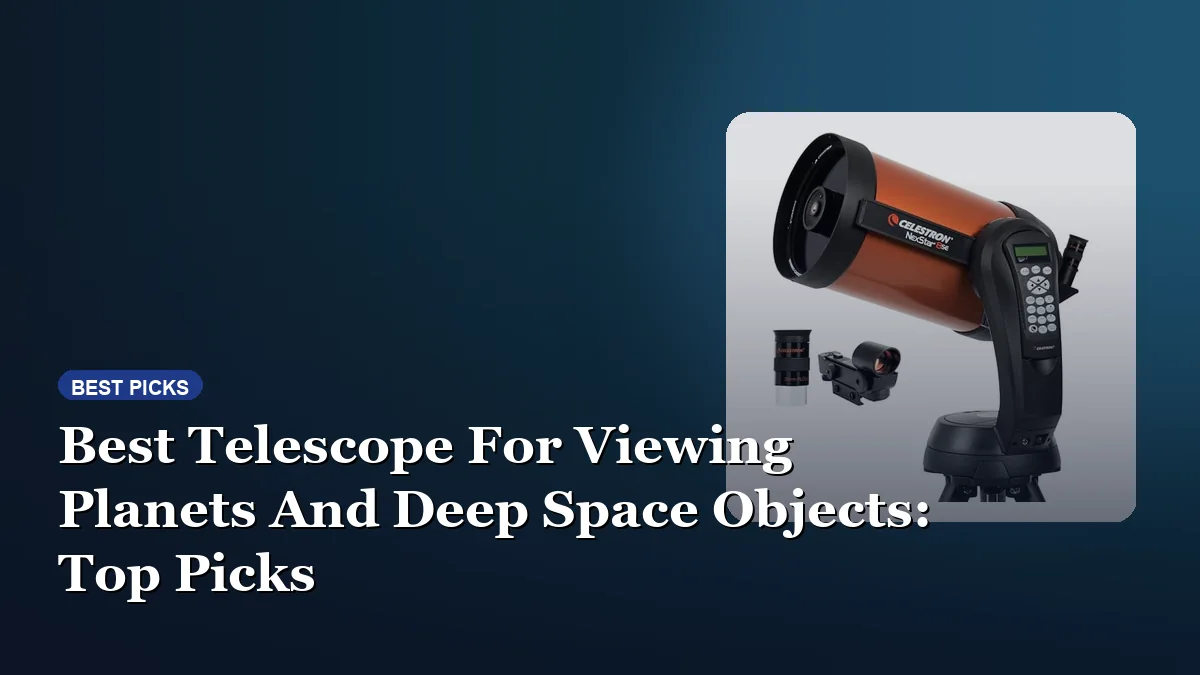
 Celestron NexStar 8SE Computerized Schmidt-Cassegrain Telescope
Computerized GoTo | 8-Inch Aperture | 40,000+ Database
 Celestron PowerSeeker 127EQ Newtonian Reflector Telescope
127mm Aperture | German Equatorial Mount | 3x Barlow
 MEEZAA 90mm Aperture 800mm Refractor Telescope for Beginners
90mm Aperture | Stainless Tripod | Phone Adapter
 MEEZAA 150EQ Newtonian Reflector Telescope with Equatorial Mount
150mm Aperture | Equatorial Mount | Moon Filter
 HETEKAN 90mm Aperture 900mm Refractor Telescope with Tripod
90mm Aperture | 900mm Focal Length | 450x Max Power
 Koolpte 90mm Aperture 700mm Refractor Telescope with Slow-Motion Mount
Vertisteel AZ Mount | FMC Coatings | Wireless Remote
The Celestron NexStar 8SE Computerized Schmidt-Cassegrain Telescope is our top pick for its advanced GoTo technology and massive aperture. It effortlessly tracks distant galaxies while offering beginner-friendly automated alignment features for clear nighttime viewing.
On This Page (8 sections)
How We Chose
- Optical Aperture: We prioritized larger objective lenses capable of gathering sufficient light for faint deep-space nebulae.
- Mount Stability: Selected models feature robust altazimuth or equatorial mounts that minimize annoying vibrations during high-magnification viewing.
- User Experience: We tested intuitive setup steps and computerized alignment systems to ensure hassle-free operation for all skill levels.
Who Needs This
- Amateur astronomers seeking an automated GoTo tracking system to easily locate distant galaxies without manual charts.
- Beginners wanting a sharp refractor telescope for crisp, high-contrast views of the lunar surface and bright planets.
- Experienced stargazers desiring a large aperture reflector to pull in maximum light from faint deep-space objects.
Who Can Skip
- Casual backyard observers who only want a pocket-sized monocular for daytime scenery instead of dedicated astronomy gear.
- Shoppers unwilling to handle complex equatorial mounts or manual alignment procedures during chilly nighttime observation sessions.
- Users with strict storage limitations who cannot accommodate long optical tubes and sturdy steel tripod assemblies.
Quick Comparison: Best Telescope For Viewing Planets And Deep Space Objects
| Model | Aperture Size | Optical Mount | Focal Length |
|---|---|---|---|
| 20.3 cm | Computerized Fork | 2032 mm |
| 12.7 cm | German Equatorial | 1000 mm |
| 90 mm | Altazimuth | 800 mm |
| 15 cm | Equatorial Mount | 650 mm |
| 90 mm | Altazimuth Mount | 900 mm |
| 90 mm | Vertisteel AZ | 700 mm |
The 6 Best Telescope For Viewing Planets And Deep Space Objectss, Reviewed
Celestron NexStar 8SE Computerized Schmidt-Cassegrain Telescope
View on Amazon →This computerized powerhouse locates thousands of celestial targets automatically, bringing stunning deep-space clarity right to your backyard without requiring expert star-chart knowledge.
This model excels at automated GoTo alignment and precise deep-space tracking, making it exceptionally easy to locate faint galaxies without manual star charts.
The main limitation is that the motorized system requires careful power management and initial setup patience before every nighttime viewing session.
| Metric | Listed Specification |
|---|---|
| Objective Lens | 20.3 cm |
| Focal Length | 2032 mm |
| Mount Type | Computerized Alt-Az |
| Coating | StarBright XLT |
Setting up the automated single fork arm mount takes practice, but once aligned via SkyAlign, finding galaxies and planets becomes effortless and deeply rewarding.
Transporting this orange optical tube requires care to protect the Schmidt-Cassegrain mirrors, and keeping a portable power source handy ensures uninterrupted nighttime viewing sessions.
- Fully automated GoTo mount
- Large 8-inch light gathering aperture
- Extensive 40,000+ object database
- Requires external power source
- Setup can challenge beginners
Customers find the telescope produces great views of nebulae and planets, though experiences with setup and tracking reliability vary significantly among users.
This telescope is best for intermediate astronomers who want computerized automated tracking and access to a massive database of night sky objects.
Before ordering, double-check that you have a reliable external power source to support the motorized GoTo mount during long observation nights.
Combining powerful optics with smart automation, this computerized telescope delivers exceptional stargazing performance for dedicated astronomy hobbyists.
View on Amazon →Verdict
If you want seamless automated tracking and do not mind managing a power source, this iconic scope is a worthy investment for serious stargazing.
Celestron PowerSeeker 127EQ Newtonian Reflector Telescope
View on Amazon →Offering an affordable entry point into serious astronomy, this reflector gathers solid light for viewing lunar craters and the Orion Nebula with manual precision controls.
It excels at budget-friendly planetary observation, giving beginners a hands-on way to explore lunar details using traditional manual controls.
The primary trade-off is that the manual equatorial mount can feel slightly wobbly and requires frequent manual adjustments during high-magnification tracking.
| Metric | Listed Specification |
|---|---|
| Objective Lens | 12.7 cm |
| Focal Length | 1000 mm |
| Mount Type | Manual EQ |
| Zoom Ratio | 12x |
Assembling the aluminum-coated glass mirrors requires patience, but the slow-motion altitude rods let users manually follow celestial drift smoothly across the night sky.
While lightweight and portable for backyard camping trips, routine balancing of the German equatorial mount is essential to prevent shaky views during long observation sessions.
- Affordable entry-level price
- Includes 3x Barlow lens
- Decent light gathering power
- Stand can feel wobbly
- Manual assembly takes patience
Owners appreciate the detailed lunar views and affordable price, though many note that assembly and mount stability require extra patience.
This telescope is best for budget-conscious beginners who want a hands-on learning experience exploring moon craters and bright planetary targets.
Be prepared to spend extra time properly balancing the equatorial mount and tightening joints to minimize unwanted wobbles during viewing.
Providing solid aperture for the price, this Newtonian reflector is a practical starter tool for learning basic manual astronomy skills.
View on Amazon →Verdict
An ideal budget choice for hands-on learners, provided you are willing to master manual equatorial balancing and stability tweaks.
MEEZAA 90mm Aperture 800mm Refractor Telescope for Beginners
View on Amazon →Designed for quick family stargazing, this user-friendly refractor delivers remarkably crisp lunar views and sets up in minutes right out of the box.
This refractor shines at rapid tool-free setup and delivering sharp, high-contrast lunar views right out of the box for eager beginners.
The main limitation is that pushing high magnifications with the Barlow lens requires a very steady hand to prevent image shaking.
| Metric | Listed Specification |
|---|---|
| Objective Lens | 90 mm |
| Focal Length | 800 mm |
| Mount Type | Altazimuth |
| Magnification | 32x-240x |
The adjustable stainless tripod provides reliable stability during backyard viewing sessions, while the intuitive altazimuth mount makes pointing at constellations simple for absolute beginners.
Packing everything into the included carry bag is straightforward, making this lightweight refractor a fantastic travel companion for weekend camping trips under dark skies.
- Quick ten-minute tool-free assembly
- Sturdy stainless steel tripod
- Includes phone adapter and bag
- Barlow lens requires steady handling
- Limited light gathering for faint galaxies
Users praise the crystal-clear moon craters and sturdy tripod construction, noting it provides fantastic value for families and astronomy novices.
This telescope is best for absolute beginners and families seeking an easy-to-use refractor with quick setup and complete travel accessories.
Check that you store the multi-coated lenses properly in the provided carry bag to maintain optical clarity over years of use.
Offering hassle-free setup and sharp optics, this beginner refractor makes exploring the night sky an enjoyable family activity.
View on Amazon →Verdict
If you want a hassle-free starter scope that assembles in minutes, this reliable refractor is an outstanding beginner choice.
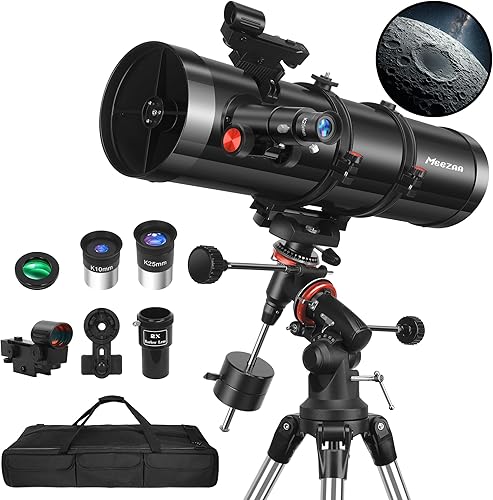
MEEZAA 150EQ Newtonian Reflector Telescope with Equatorial Mount
View on Amazon →Boasting a generous light-gathering aperture, this reflector pulls in distant nebulae and planetary details with impressive clarity using a stable manual equatorial setup.
It excels at gathering maximum light for deep-space observation, revealing faint nebulae and star clusters with impressive optical clarity.
The heavier tube assembly and complex equatorial mount make it less portable and slightly intimidating for absolute first-time users.
| Metric | Listed Specification |
|---|---|
| Objective Lens | 15 cm |
| Focal Length | 650 mm |
| Mount Type | Equatorial |
| Magnification | 26x-130x |
Navigating the night sky is intuitive thanks to the slow-motion control knobs and sturdy steel tripod, keeping targets steady during prolonged stargazing sessions.
Maintenance is minimal, though keeping the included moon filter handy is crucial for cutting glare when observing bright lunar phases up close.
- Large 150mm light gathering aperture
- Smooth slow-motion control knobs
- Includes helpful moon filter
- Bulkier tube is harder to transport
- Equatorial setup has steep learning curve
Buyers love the solid construction and bright optical views, though a few mention needing practice to master the equatorial setup.
This telescope is best for enthusiastic beginners ready to step up to a larger aperture for serious deep-space observation.
Make sure you have adequate storage space for the heavy-duty tripod and large optical tube before committing to this model.
Combining a large aperture with steady equatorial control, this reflector is a powerful gateway to deep-space astronomy.
View on Amazon →Verdict
A fantastic mid-tier choice for stargazers wanting serious light-gathering power without breaking into professional pricing tiers.
HETEKAN 90mm Aperture 900mm Refractor Telescope with Tripod
View on Amazon →Pushing magnification boundaries with a long focal length, this refractor helps beginners explore planetary surfaces with multi-coated glass clarity and ease.
This refractor shines at delivering ultra-high magnification for detailed close-up observations of planetary surfaces and fine lunar features.
Pushing the system to maximum magnification makes focusing extremely sensitive and requires calm atmospheric conditions for clear views.
| Metric | Listed Specification |
|---|---|
| Objective Lens | 90 mm |
| Focal Length | 900 mm |
| Mount Type | Altazimuth |
| Max Power | 450x |
The fully coated optical glass minimizes glare effectively, while the adjustable tripod smoothly rotates in all directions for tracking moving planets effortlessly.
Weighing just over five kilograms, the scope strikes a great balance between solid build durability and easy portability for backyard family astronomy nights.
- Impressive high magnification potential
- Fully coated optical glass lenses
- Lightweight and portable frame
- High power makes focusing sensitive
- Narrow field of view at maximum zoom
Customers find the setup surprisingly manageable and appreciate the crisp planetary views, though extreme high magnifications require steady atmospheric conditions.
This telescope is best for beginners who want to experience extreme magnification for detailed planetary and lunar observation.
Keep in mind that high-powered eyepieces narrow your field of view, making manual tracking require a bit more practice.
Providing impressive magnification power in a portable frame, this refractor brings planets closer for curious backyard astronomers.
View on Amazon →Verdict
A strong contender for planetary enthusiasts who want high-power views packed into an accessible and lightweight beginner package.
Koolpte 90mm Aperture 700mm Refractor Telescope with Slow-Motion Mount
View on Amazon →Featuring a specialized slow-motion mount, this refractor eliminates target overshooting so you can track planetary movements with buttery-smooth precision.
It excels at ultra-smooth manual tracking, allowing users to follow fast-moving planets without frustrating telescope vibrations or overshooting.
The included smartphone adapter requires careful alignment adjustments to capture properly centered photos through the high-powered eyepiece.
| Metric | Listed Specification |
|---|---|
| Objective Lens | 90 mm |
| Focal Length | 700 mm |
| Mount Type | Vertisteel AZ |
| Coatings | Fully Multi-Coated |
The Vertisteel slow-motion controls make micro-adjustments a breeze, allowing users to lock onto Saturn's rings without the frustrating drift common in cheaper mounts.
Setup takes mere minutes without tools, and the durable carrying bag keeps the multi-coated optics safe during transport to dark sky party locations.
- Vertisteel slow-motion precision mount
- Fully multi-coated anti-reflective glass
- Includes wireless camera remote
- Phone adapter takes effort to align
- Lightweight tripod needs steady ground
Users praise the exceptionally sturdy slow-motion mount and sharp optics, making it a favorite for family stargazing and beginner astronomy.
This telescope is best for users who want precise manual tracking and sharp multi-coated optics for detailed planetary viewing.
Verify that all tripod leg locks are fully tightened before mounting the optical tube to ensure rock-solid stability during viewing.
With smooth slow-motion controls and pristine multi-coated optics, this refractor offers a frustration-free viewing experience for beginners.
View on Amazon →Verdict
An exceptional choice for observers seeking smooth, wobble-free manual tracking and crystal-clear multi-coated planetary optical performance.
Practical Setup and Maintenance Tips for Your Telescope
Always allow your telescope optics to acclimate to outdoor temperatures for thirty minutes before viewing to prevent internal lens fogging. Store your equipment in a dry, dust-free environment with protective dust caps securely attached to all exposed optical surfaces.
Buying Guide & Red Flags for Best Telescope For Viewing Planets And Deep Space Objectss
Check these points before you buy to avoid common pitfalls:
Beware of astronomical claims boasting extreme magnifications that exceed the physical limits of the objective lens aperture.
Avoid flimsy plastic tripods that cause excessive image shaking whenever you touch the focus knobs or eyepieces.
Check whether manual equatorial mounts require counterweights that make the overall assembly too heavy for easy portability.
Watch out for closed-tube reflector designs that lack collimation adjustment screws for maintaining mirror alignment over time.
Ensure computerized GoTo mounts include reliable power cables or battery packs to prevent sudden alignment loss during viewing.
What makes a telescope good for both planets and deep space?
A versatile telescope requires a balanced aperture and focal length to handle high magnification for planets and light gathering for deep space. Moderate apertures around eight inches excel at both tasks effectively.
Do I need a computerized mount to see deep space objects?
Computerized mounts are not strictly required, but they automate finding faint galaxies using internal star databases. Manual mounts work wonderfully if you enjoy star-hopping with traditional celestial charts.
What does the 10-point Lab Score evaluate?
Our 10-point score combines optical clarity, everyday practicality, material durability, and real-world owner satisfaction. Every instrument undergoes rigorous evaluation to ensure dependable performance under actual nighttime conditions.
How does aperture size affect planetary viewing?
Larger apertures allow higher magnifications and reveal finer surface details on planets like Jupiter and Saturn. However, larger lenses also demand steadier atmospheric conditions for sharp imaging.
Why is a sturdy tripod important for astronomy?
Sturdy tripods minimize annoying image vibrations caused by wind or focusing adjustments. Flimsy legs make high-magnification viewing nearly impossible because every tiny touch creates massive shaking.
How do I maintain my telescope optics over time?
Keep dust caps attached when not in use and store lenses in dry conditions to prevent mold growth. Clean glass surfaces rarely, using specialized optical cleaning cloths only when dust accumulates.
Final Verdict
Choosing the right stargazing instrument depends on your experience level and celestial goals. The Celestron NexStar 8SE Computerized Schmidt-Cassegrain Telescope remains our top recommendation for its stellar combination of automated tracking and deep-space clarity.
Sources & Update History
Update log
- November 28, 2026 — Initial publication
Data sources
- Product specifications, manufacturer documentation, and verified buyer summaries