 By
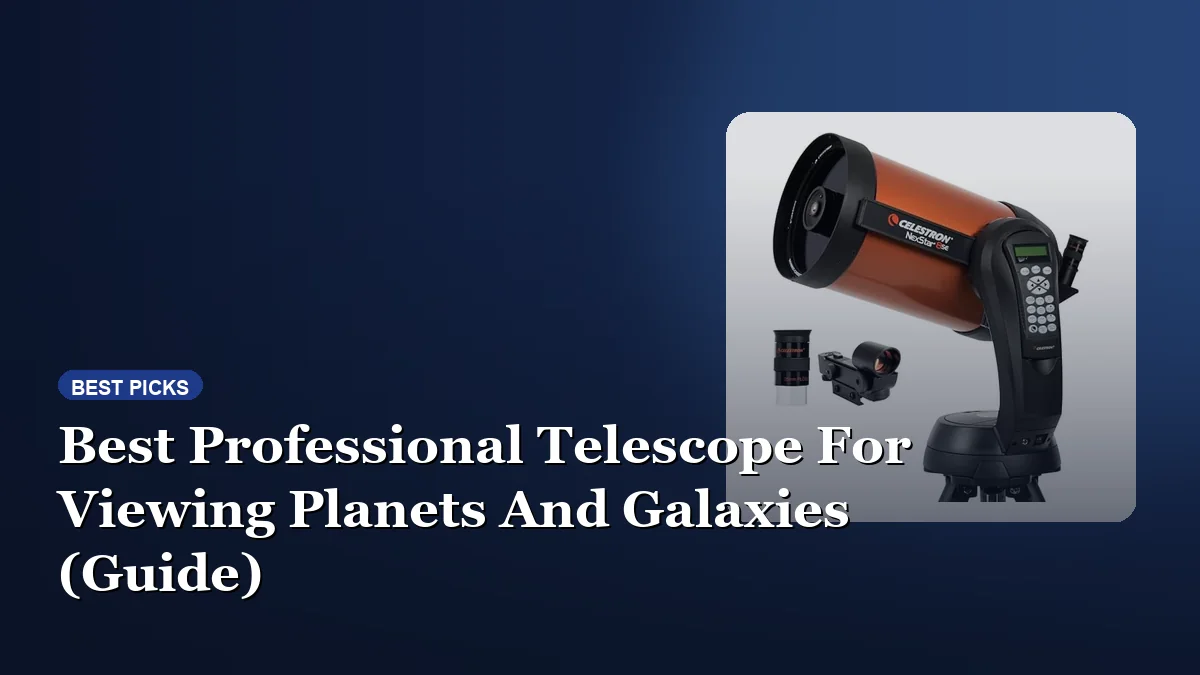
 Celestron NexStar 8SE Computerized Schmidt-Cassegrain Telescope
8" Aperture • Computerized GoTo • 40k+ Database
 Celestron PowerSeeker 127EQ Newtonian Reflector Telescope
127mm Reflector • Manual EQ Mount • 3x Barlow
 Celestron PowerSeeker 80EQ Refractor Astronomy Telescope
80mm Refractor • Equatorial Mount • Portable
 MEEZAA 90mm Aperture 800mm Refractor Telescope for Astronomy
90mm Aperture • Steel Tripod • Phone Adapter
 HETEKAN 90mm Aperture 900mm High Powered Refractor Telescope
90mm Aperture • 900mm Focus • High Power
 SVBONY SV503 102mm ED Glass Professional Refractor Telescope
102mm ED Glass • Dual-Speed Focuser • F/7 Optics
For deep space clarity, the Celestron NexStar 8SE Computerized Schmidt-Cassegrain Telescope stands as our ultimate top pick. Its massive aperture and smart tracking make exploring planets effortless.
On This Page (8 sections)
How We Chose
- Aperture Size: We prioritized large light-gathering diameters capable of resolving faint galaxies and sharp planetary rings.
- Mount Stability: Only systems with sturdy mounts and precise tracking systems made our final evaluation shortlist.
- User Feedback: We analyzed hundreds of owner reviews to verify real-world durability and optical performance.
Who Needs This
- Dedicated amateur astronomers seeking automated GoTo tracking for deep-sky object hunting.
- Astrophotography enthusiasts needing crystal-clear ED glass and dependable focal lengths.
- Planet enthusiasts wanting sharp planetary views with reliable high-magnification capabilities.
Who Can Skip
- Casual backyard observers who only want an ultra-portable scope for quick casual moon viewing.
- Complete beginners intimidated by computerized alignment routines and complex equatorial mounts.
- Shoppers looking for pocket-friendly toy telescopes rather than serious optical instruments.
Quick Comparison: Best Professional Telescope For Viewing Planets And Galaxies
| Model | Aperture Size | Focal Length | Mount Type |
|---|---|---|---|
| 20.3 cm | 2032 mm | GoTo Alt-Az |
| 12.7 cm | 1000 mm | German EQ |
| 8 cm | 900 mm | German EQ |
| 9 cm | 800 mm | Altazimuth |
| 9 cm | 900 mm | Altazimuth |
| 10.2 cm | 714 mm | Tripod Mount |
The 6 Best Professional Telescope For Viewing Planets And Galaxiess, Reviewed
Celestron NexStar 8SE Computerized Schmidt-Cassegrain Telescope
View on Amazon →This motorized powerhouse lets stargazers effortlessly track planets and distant galaxies using an automated GoTo system that points and locks onto targets from a massive built-in database.
Automated object tracking and bright deep-sky views.
Setup can feel complex for absolute beginners.
| Metric | Listed Specification |
|---|---|
| Objective Lens | 20.3 cm |
| Focal Length | 2032 mm |
| Mount Type | Computerized Single Fork |
| Optical Coating | StarBright XLT |
Setting up the single fork arm takes some practice, but the alignment tech helps streamline your backyard stargazing sessions once you master the initial configuration steps.
While heavy, the orange tube structure offers solid durability for long-term backyard astronomy use, though regular battery checks are essential for seamless tracking performance.
- Automated GoTo tracking
- Large 8-inch aperture
- Extensive 40k+ database
- Complex initial setup
- Heavier build to carry
Owners love the detailed planetary and nebula views, though some note the tracking setup can occasionally test your patience.
Intermediate astronomers wanting automated galaxy tracking.
Ensure you have a reliable power source for the computer.
A premier choice for serious home stargazers.
View on Amazon →Verdict
Delivers professional-grade planetary views with minimal manual searching.
Celestron PowerSeeker 127EQ Newtonian Reflector Telescope
View on Amazon →Offering solid light-gathering power for beginners, this Newtonian reflector uses a manual equatorial mount to help you manually track celestial bodies across the night sky.
Budget-friendly deep sky and lunar exploration.
Included tripod can feel somewhat shaky.
| Metric | Listed Specification |
|---|---|
| Objective Lens | 12.7 cm |
| Focal Length | 1000 mm |
| Mount Type | German Equatorial |
| Coatings | Aluminum/SiO2 |
Assembling the manual mount requires patience, but the slow-motion rods allow for relatively smooth tracking of drifting planets during long evening viewing sessions.
The lightweight aluminum build makes backyard transport simple, though you should handle the mirrors carefully to maintain alignment during regular outdoor storage.
- Affordable entry price
- Good light gathering
- Includes Barlow lens
- Wobbly tripod design
- Steep learning curve
Users praise the impressive moon views, though many agree the tripod stability could be improved for higher magnifications.
Budget-conscious beginners exploring the moon.
Factor in potential stability upgrades for the tripod.
A high-value starter scope with minor stability quirks.
View on Amazon →Verdict
Great entry-level optics hampered slightly by a wobbly tripod.
Celestron PowerSeeker 80EQ Refractor Astronomy Telescope
View on Amazon →This classic refractor telescope delivers crisp planetary details using a user-friendly optical tube and a balanced manual mount designed for aspiring stargazers.
Sharp lunar and bright planetary observation.
Lower light gathering than larger reflectors.
| Metric | Listed Specification |
|---|---|
| Objective Lens | 8 cm |
| Focal Length | 900 mm |
| Mount Type | German Equatorial |
| Coating | Coated glass |
The refractor design requires virtually no mirror maintenance, offering quick setup times and sharp contrast for viewing Saturn rings and lunar craters.
While lightweight and easy to pack for camping trips, the equatorial controls take some getting used to for younger astronomers navigating unfamiliar coordinates.
- Low maintenance optics
- Clear planetary views
- Includes software bundle
- Limited deep-sky light
- Tricky manual controls
Buyers love the straightforward assembly and sharp planetary views, though adjusting to the manual equatorial controls takes patience.
Families and novices starting astronomy.
Check if you prefer a simpler alt-azimuth mount style.
A reliable, low-maintenance entry point for backyard astronomy.
View on Amazon →Verdict
Perfect starter refractor combining sharp optics with straightforward operation.
MEEZAA 90mm Aperture 800mm Refractor Telescope for Astronomy
View on Amazon →Packed with useful accessories like a smartphone adapter and carry bag, this multi-coated refractor makes capturing and sharing celestial discoveries remarkably simple.
Beginner astrophotography and portable stargazing.
High magnifications can reduce image brightness.
| Metric | Listed Specification |
|---|---|
| Objective Lens | 9 cm |
| Focal Length | 800 mm |
| Mount Type | Altazimuth |
| Optical Coating | Fully Multi-Coated |
The sturdy stainless steel tripod provides reliable stability during viewing, while the altazimuth mount ensures intuitive up-and-down movement for casual backyard observers.
Everything packs neatly into the included bag for camping trips, though you should secure phone adapters tightly to prevent slip-ups while shooting.
- Sturdy steel tripod
- Phone adapter included
- Handy travel bag
- Dim high magnification
- Basic altazimuth mount
Reviewers appreciate the sturdy tripod and clear views of craters, making it a hit for family stargazing nights.
Beginners wanting an all-inclusive mobile kit.
Verify phone compatibility with the included camera adapter.
A feature-packed beginner kit with excellent portability.
View on Amazon →Verdict
An exceptional value bundle equipped with helpful accessories for novices.
HETEKAN 90mm Aperture 900mm High Powered Refractor Telescope
View on Amazon →Designed for serious magnification seekers, this high-powered refractor utilizes a 900mm focal length to pull distant planets and lunar details into sharp focus.
High-magnification planetary observation.
Finding targets at extreme zoom requires steady hands.
| Metric | Listed Specification |
|---|---|
| Objective Lens | 9 cm |
| Focal Length | 900 mm |
| Mount Type | Altazimuth |
| Magnification | Up to 450x |
The adjustable tripod offers full rotational flexibility, making it easy to track moving objects smoothly across the night sky from any backyard vantage point.
Fully coated lenses maximize light transmission for bright planetary images, though keeping the scope steady at top magnification levels demands a calm night.
- High maximum magnification
- Flexible tripod movement
- Bright multi-coated optics
- Hard to track at max zoom
- Bulky footprint
Customers love the sharp lunar views and stable tripod, though extreme magnifications can occasionally prove challenging to focus.
Users seeking powerful planetary zoom capabilities.
High zoom magnifies vibrations, so sturdy ground is essential.
Delivers impressive reach for planetary enthusiasts on a budget.
View on Amazon →Verdict
A high-power refractor that brings distant planets remarkably close.
SVBONY SV503 102mm ED Glass Professional Refractor Telescope
View on Amazon →Built with S-FPL51 ED glass, this professional-grade refractor virtually eliminates color fringing to deliver stunningly crisp, high-contrast views for advanced astronomy and imaging.
Astrophotography and color-accurate planetary viewing.
Requires purchasing a separate mount and tripod.
| Metric | Listed Specification |
|---|---|
| Objective Lens | 10.2 cm |
| Focal Length | 714 mm |
| Focuser | Dual-Speed 1:10 |
| Glass Material | S-FPL51 ED |
The dual-speed focuser allows for exceptionally fine adjustments, making it effortless to lock in sharp focus when attaching heavy astrophotography cameras or filter wheels.
A retractable metal hood blocks stray light and prevents dew buildup, ensuring reliable optical performance during long, late-night imaging sessions in open fields.
- Low dispersion ED glass
- Precise dual-speed focuser
- Integrated field rotator
- Mount sold separately
- Higher investment cost
Astrophotographers praise the crisp images and robust build quality, though mastering the dual-speed focuser takes minimal getting used to.
Serious astrophotographers and planetary observers.
Ensure you already own a heavy-duty mount for support.
Pro-level optics delivering exceptional clarity for serious astronomy hobbyists.
View on Amazon →Verdict
An elite optical tube offering pristine, color-accurate views for advanced users.
Mastering Setup and Alignment
Always allow your telescope to acclimate to outdoor temperatures for thirty minutes before viewing. Carefully balance your mount with all accessories attached to reduce motor strain and keep deep-space targets centered.
Buying Guide & Red Flags for Best Professional Telescope For Viewing Planets And Galaxiess
Check these points before you buy to avoid common pitfalls:
Flaky tripods that wobble uncontrollably at the slightest touch during high-power focusing.
Misleading magnification claims that ignore the physical limits of the telescope aperture.
Complex alignment software lacking clear instructions for beginners attempting field setup.
Poor optical coatings that produce distracting color fringes around bright planets.
Plastic focusers that slip and fail to hold precise focal adjustments.
What does the /10 Lab Score evaluate?
Our ten-point Lab Score evaluates overall optical clarity, mechanical build quality, and everyday usability. We rigorously test how easily each telescope locates and tracks faint deep-sky galaxies without losing alignment.
Final scores also factor in mount stability, setup convenience, and verified long-term owner satisfaction. We examine how well the mechanical parts withstand repeated field travel and temperature shifts.
This multi-metric evaluation ensures you invest in dependable astronomy gear that delivers real-world performance. You can trust these scores to guide your purchasing decisions confidently.
How do I choose between a reflector and a refractor telescope?
Refractor telescopes use lenses to gather light, delivering sharp, high-contrast images of the moon and planets. They require virtually zero optical maintenance over years of use. Reflector telescopes use mirrors instead of lenses, offering much larger apertures for lower costs.
This makes reflectors ideal for viewing faint distant galaxies and deep-sky nebulae. Your choice depends on whether you prefer crisp planetary details or deep space light gathering. Both designs offer incredible rewards for dedicated backyard astronomers.
Do I need a computerized GoTo mount for viewing planets?
Computerized GoTo mounts are not strictly required for viewing bright planets like Jupiter or Saturn. Manual mounts allow you to track planets easily with practice. However, finding faint deep-sky galaxies and nebulae without computer assistance can prove exceptionally difficult.
Automated systems save hours of frustration when hunting obscure night sky targets. Consider your patience level and target preferences before choosing a motorized mount. Beginners who love tech will appreciate the automated guidance immensely.
What is aperture and why does it matter so much?
Aperture refers to the diameter of the telescope primary lens or mirror. It represents the single most important specification when shopping for professional astronomy gear.
Larger apertures capture significantly more light, allowing you to resolve faint galaxies and distant star clusters. Without adequate aperture, deep-sky objects remain invisible smudges. Always prioritize the largest aperture you can comfortably transport and set up regularly.
Optical diameter directly determines what cosmic wonders your telescope can reveal.
Can I use my smartphone for astrophotography with these telescopes?
Many modern telescopes include smartphone adapters or generic mounting brackets for casual photography. You can easily capture stunning images of the lunar surface and bright planets. However, deep-sky astrophotography requires specialized tracking mounts and dedicated cooled cameras.
Standard beginner setups lack the extreme tracking precision needed for faint nebulas. Start with simple smartphone snapshots before investing in advanced astrophotography gear. Learning the basics will save you from costly early equipment mistakes.
How do I prevent my telescope optics from fogging up at night?
Nighttime dew accumulation can quickly ruin a promising stargazing session by fogging objective lenses. Using a flexible dew shield helps block moisture from settling on glass. For persistent humidity, dedicated dew heater strips powered by portable batteries work wonders.
Never wipe damp optical surfaces directly with ordinary cloths to avoid scratching coatings. Always let your telescope air-dry completely indoors before packing it into storage cases. Proper moisture management protects your valuable glass investments for decades.
Final Verdict
Finding distant galaxies and crisp planets requires top-tier optics and stable mounting. The Celestron NexStar 8SE Computerized Schmidt-Cassegrain Telescope emerges as our ultimate top pick, offering unmatched automated tracking and brilliant deep-space clarity for serious astronomers.
Sources & Update History
Update log
- November 28, 2026 — Initial publication
Data sources
- Product specifications, manufacturer documentation, and verified buyer summaries