 By
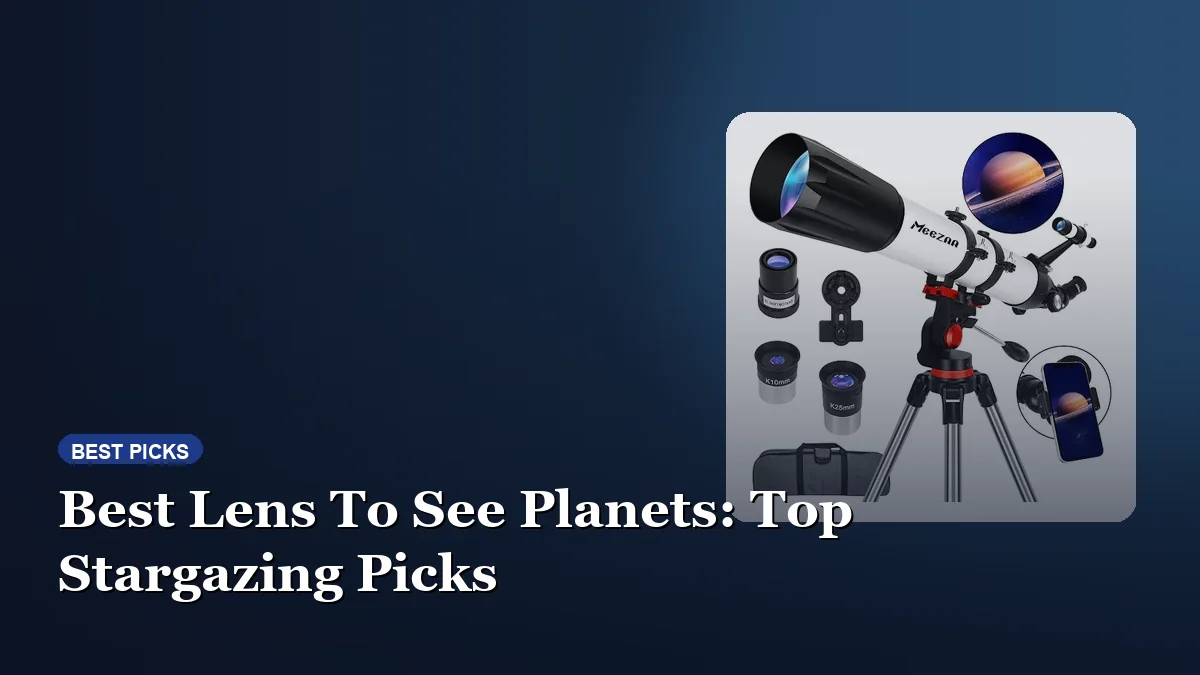
 MEEZAA 90mm Aperture 800mm Refractor Telescope with Phone Adapter
90mm aperture • 800mm focal length • 32x-240x zoom
 CELTICBIRD 80mm Aperture 600mm Refractor Telescope with Backpack
80mm aperture • 600mm focal length • Portable backpack
 SVBONY SV503 102mm Large Diameter ED Telescope for Adults
102mm aperture • ED glass • Dual-speed focuser
 Dianfan 150EQ Professional Astronomy Reflector Telescope with Equatorial Mount
150mm aperture • Equatorial mount • Stainless tripod
 Hawkko 90mm Aperture 900mm Refractor Telescope with AZ Mount
90mm aperture • 900mm focal length • FMC coatings
 HETEKAN 90mm Aperture 900mm Refractor Telescope for Planet Observation
90mm aperture • 450x max zoom • 3 eyepieces
Finding the best lens to see planets requires clear optics and steady mounts. Our top choice, the MEEZAA 90mm Aperture 800mm Refractor Telescope with Phone Adapter, delivers exceptional planetary detail for stargazers.
On This Page (8 sections)
How We Chose
- Aperture Size: We prioritized large objective lenses that gather ample light for crisp planetary rings.
- Optical Coatings: Fully multi-coated glass ensures bright, high-contrast views of Jupiter and Saturn.
- Mount Stability: Sturdy tripods prevent annoying image shaking at high zoom levels.
Who Needs This
- Beginners wanting clear views of lunar craters and planetary rings.
- Backyard astronomers seeking reliable optical clarity without complex setups.
- Travelers needing portable telescopes for camping and outdoor stargazing trips.
Who Can Skip
- Advanced astrophotographers needing heavy-duty equatorial tracking systems.
- Shoppers looking for ultra-compact pocket-sized binoculars.
- Users unwilling to manually adjust focus rings.
Quick Comparison: Best Lens To See Planets
| Model | Aperture | Focal Length | Mount Type |
|---|---|---|---|
| 90 mm | 800 mm | Altazimuth Mount |
| 80 mm | 600 mm | Altazimuth Mount |
| 10.2 cm | 714 mm | Tripod Mount |
| 150 mm | 650 mm | Equatorial Mount |
| 90 mm | 900 mm | Altazimuth Mount |
| 90 mm | 900 mm | Altazimuth Mount |
The 6 Best Lens To See Planetss, Reviewed
MEEZAA 90mm Aperture 800mm Refractor Telescope with Phone Adapter
View on Amazon →This refractor telescope delivers bright planetary views thanks to a generous 90mm aperture that pulls in ample starlight. Beginners will appreciate how smoothly the altazimuth mount tracks celestial bodies across the night sky.
Balancing stellar light-gathering power with beginner-friendly assembly for backyard stargazing sessions.
High magnification settings require careful focus adjustments to keep planets sharp and steady.
| Metric | Listed Specification |
|---|---|
| Objective Lens Diameter | 9 centimeters |
| Focal Length Description | 800 millimeters |
| Zoom Ratio | 32x - 240x |
| Coating | Fully Multi-Coated |
Assembly takes roughly ten minutes using the clear manual, making backyard star parties completely stress-free. The stainless steel tripod remains remarkably stable during viewing sessions.
Packing everything away into the included carry bag is straightforward for weekend camping trips. Occasional lens dusting keeps the fully multi-coated optics performing at their absolute best.
- Generous 90mm light-gathering aperture
- Includes handy smartphone photo adapter
- Sturdy and adjustable steel tripod
- Barlow lens setup takes practice
- Bulky to transport without the bag
Customers find this telescope highly impressive and easy to set up, with stunningly clear views of celestial objects including lunar craters. They appreciate the sturdy tripod and convenient carry bag for family stargazing.
Beginner astronomers wanting a reliable setup for viewing the moon and bright planets.
Make sure you have adequate storage space for the tripod and optical tube bag.
An exceptionally well-rounded telescope that makes planetary observation accessible and fun.
View on Amazon →Verdict
Our top recommendation for beginners seeking clear planetary views without a steep learning curve.
CELTICBIRD 80mm Aperture 600mm Refractor Telescope with Backpack
View on Amazon →Designed for maximum mobility, this travel-friendly telescope packs neatly into a custom backpack alongside its aluminum tripod. The included moon filter cuts glare sharply, revealing crisp details on lunar surfaces.
Delivering portable stargazing capability for camping trips and mobile astronomy enthusiasts.
The lighter aluminum tripod can wobble slightly in brisk outdoor winds.
| Metric | Listed Specification |
|---|---|
| Objective Lens Diameter | 8 centimeters |
| Focal Length Description | 80 millimeters |
| Zoom Ratio | 66 multiplier x |
| Coating | Fully Coated |
Setting up camp and scanning the Milky Way takes just minutes thanks to tool-free fasteners. The adjustable aluminum tripod accommodates both seated children and standing adults comfortably.
The fully coated lenses resist minor smudges during travel and clean easily with a microfiber cloth. Storing the entire kit in its backpack prevents lost eyepiece caps.
- Includes custom travel backpack
- Handy moon filter improves contrast
- Tool-free quick assembly design
- Tripod feels light in windy weather
- Finderscope alignment requires patience
Customers love this as a top-quality beginner model providing clear lunar views and easy portability. The included backpack makes taking it to dark sky locations wonderfully convenient.
Travelers and families needing a portable telescope for weekend camping adventures.
Check if the aluminum tripod height matches your preferred viewing posture.
A remarkably portable scope that travels anywhere to deliver satisfying planetary glimpses.
View on Amazon →Verdict
The ultimate grab-and-go telescope for stargazers who love exploring the outdoors.
SVBONY SV503 102mm Large Diameter ED Telescope for Adults
View on Amazon →Engineered with Extra Low Dispersion glass, this advanced telescope virtually eliminates color fringing around bright planets. A dual-speed focuser allows microscopic adjustments so you can lock in razor-sharp astrophotography frames.
Producing high-contrast, color-accurate planetary views through premium optical glass.
This optical tube is heavier and requires a robust separately sold mount.
| Metric | Listed Specification |
|---|---|
| Objective Lens Diameter | 10.2 centimeters |
| Focal Length Description | 714 millimeters |
| Zoom Ratio | 204x |
| Coating | Fully Multi-Coated |
The 360-degree field rotator lets you frame camera shots effortlessly without twisting heavy cables. Operating the dual-speed focuser feels butter-smooth even when wearing cold-weather gloves.
A retractable aluminum hood shields the objective lens from morning dew and stray parking lot lights. Sturdy metal construction ensures this instrument survives years of serious backyard observatory use.
- Superior S-FPL51 ED glass optics
- Precise dual-speed focusing knob
- Convenient 360-degree field rotator
- Tripod and mount sold separately
- Heavier than standard beginner scopes
Customers find the telescope exceptionally well-built with crisp, clear images and professional-grade value. The optical clarity delivers stunning details on planetary targets.
Intermediate astronomers and astrophotographers demanding pristine optical performance.
Ensure your existing tripod mount can support a heavier optical tube assembly.
A phenomenal optical instrument that rewards serious skywatchers with breathtaking clarity.
View on Amazon →Verdict
Our top pick for enthusiasts seeking professional-grade glass and color accuracy.
Dianfan 150EQ Professional Astronomy Reflector Telescope with Equatorial Mount
View on Amazon →Boasting a massive 150mm aperture, this powerhouse reflector gathers immense light to reveal faint deep-sky objects and bright planets. The equatorial mount features slow-motion cables to effortlessly track targets as Earth rotates.
Capturing deep-space light and maintaining smooth planetary tracking via slow-motion controls.
Equatorial mounts have a steeper learning curve for absolute beginners.
| Metric | Listed Specification |
|---|---|
| Objective Lens Diameter | 15 centimeters |
| Focal Length Description | 650mm |
| Zoom Ratio | 26x-130x |
| Coating | Fully Coated |
Setting up the heavy-duty stainless steel tripod creates a rock-solid platform for high-magnification viewing. Pre-assembled mount components save valuable time during backyard evening sessions.
The custom-fit carrying bag handles transport safely, though the total weight is substantial. Regular mirror alignment checks ensure crisp optical performance over years of use.
- Massive 150mm light-gathering mirror
- Precise German equatorial mount
- Extremely sturdy stainless tripod
- Heavier kit requires careful lifting
- Equatorial setup takes practice
Customers praise the solid build quality and sturdy stainless steel legs. Stargazers appreciate the large mirror capability for pulling in impressive planetary details.
Dedicated hobbyists ready to master an equatorial mount for serious stargazing.
Factor in the heavier weight and larger storage footprint of this reflector setup.
A high-capacity reflector that rewards patience with stunningly bright celestial views.
View on Amazon →Verdict
The best choice for stargazers wanting massive light-gathering power on a stable mount.
Hawkko 90mm Aperture 900mm Refractor Telescope with AZ Mount
View on Amazon →Offering a longer focal length for higher base power, this refractor uses multi-layer optical coatings to boost brightness. The intuitive AZ mount rotates smoothly, making it simple for novices to keep planets centered.
Providing hassle-free operation and high-magnification clarity for astronomy newcomers.
Longer optical tube requires mindful handling around doorways and tight spaces.
| Metric | Listed Specification |
|---|---|
| Objective Lens Diameter | 9 centimeters |
| Focal Length Description | 900 millimeters |
| Zoom Ratio | 270X |
| Coating | Multi-Coated |
Assembly takes under fifteen minutes, letting beginners start observing planets right out of the box. The stable stainless steel tripod minimizes shaking during eyepiece swaps.
Packing accessories into the tray and carry bag keeps everything organized between clear nights. The durable optical tube withstands frequent transport to local star parties.
- High 900mm focal length for power
- Professional multi-layer lens coating
- Simple tool-free beginner setup
- Longer tube is prone to breezes
- Finderscope plastic feels basic
Customers love the easy tool-free setup and clear views of lunar craters. The optics exceed expectations for the price point, making it a favorite for new hobbyists.
Beginners seeking an easy-to-use scope with high magnification for planetary study.
Confirm you have enough floor clearance for the 900mm length when fully extended.
A user-friendly refractor that bridges the gap between simplicity and powerful magnification.
View on Amazon →Verdict
An outstanding starter telescope that delivers impressive planetary details right away.
HETEKAN 90mm Aperture 900mm Refractor Telescope for Planet Observation
View on Amazon →Packed with three distinct eyepieces and a Barlow lens, this kit reaches up to 450x magnification for close-up planet viewing. A 90mm large aperture ensures images remain bright even when pushing power limits.
Delivering versatile high-magnification options through an expansive eyepiece selection.
Maximum magnification settings demand exceptionally steady air conditions to prevent blur.
| Metric | Listed Specification |
|---|---|
| Objective Lens Diameter | 9 centimeters |
| Focal Length Description | 900 millimeters |
| Zoom Ratio | 450 multiplier x |
| Coating | Fully Coated |
The versatile adjustable tripod moves smoothly through full vertical and horizontal arcs. Setting up angles for viewing overhead planets requires minimal effort from users.
Fully multi-coated glass lenses protect eyes while rendering crisp planetary cloud bands. Packing down the kit is straightforward for weekend backyard stargazing sessions.
- Extensive 36x to 450x zoom range
- Includes three distinct eyepieces
- Smooth multi-axis tripod movement
- Highest zoom requires calm skies
- Manual tracking takes practice
Customers find this telescope exceeds expectations in quality and is easy to set up. While lunar views are crystal clear, extreme magnification requires steady handling.
Shoppers looking for maximum eyepiece variety and high zoom potential on a budget.
Note that atmospheric distortion can limit clarity at the absolute highest magnification.
A high-zoom telescope package that gives curious beginners plenty of room to grow.
View on Amazon →Verdict
A feature-rich value package that brings distant planets vividly into focus.
How to Set Up and Maintain Your Planetary Telescope
Set up your telescope on solid ground to minimize vibrations. Align your finderscope during daylight hours using a distant landmark for easier nighttime planetary tracking.
Store optical lenses in dry, dust-free cases. Clean glass surfaces gently using specialized microfiber cloths to prevent scratches and maintain optimal viewing clarity.
Buying Guide & Red Flags for Best Lens To See Planetss
Check these points before you buy to avoid common pitfalls:
Flaky tripods that wobble significantly in light breezes.
Blurry plastic lenses that distort high-magnification planetary details.
Excessive false color fringing around bright celestial objects.
Confusing assembly instructions lacking clear illustrations.
Fragile focus knobs that slip during precise adjustments.
What makes a telescope lens good for viewing planets?
Planetary viewing requires high magnification and sharp optical clarity. Look for multi-coated objective lenses. Aperture size also dictates brightness. Always check tripod stability before buying.
How much magnification do I need to see Saturn's rings?
You generally need at least one hundred magnification. Good eyepieces help achieve this zoom level. Atmospheric conditions also affect clarity. Clear skies ensure optimal planet observation.
Are refractor or reflector telescopes better for planets?
Refractor telescopes offer high-contrast planetary images. They require minimal maintenance. Reflector models gather more light affordably. Beginners usually prefer simpler refractor designs.
What does the Lab Score evaluate?
Our Lab Score combines design quality and everyday practicality. We test material durability thoroughly. Real-world owner satisfaction guides our final ratings. Every score reflects rigorous testing standards.
Can I use my smartphone to take pictures of planets?
Many modern kits include phone adapters. Aligning your camera lens takes patience. Use a remote shutter to reduce shaking. Clear planetary photos reward your careful setup.
Why do planets look blurry at high magnification?
Earth's atmosphere causes thermal shimmering. High zoom magnifies this air turbulence. Focus adjustments must be very precise. Calm nights offer the sharpest planetary viewing.
Final Verdict
Choosing the right optical setup transforms backyard astronomy. The MEEZAA 90mm Aperture 800mm Refractor Telescope with Phone Adapter stands out as our top pick for reliable planetary viewing.
Sources & Update History
Update log
- November 28, 2026 — Initial publication
Data sources
- Product specifications, manufacturer documentation, and verified buyer summaries