 By
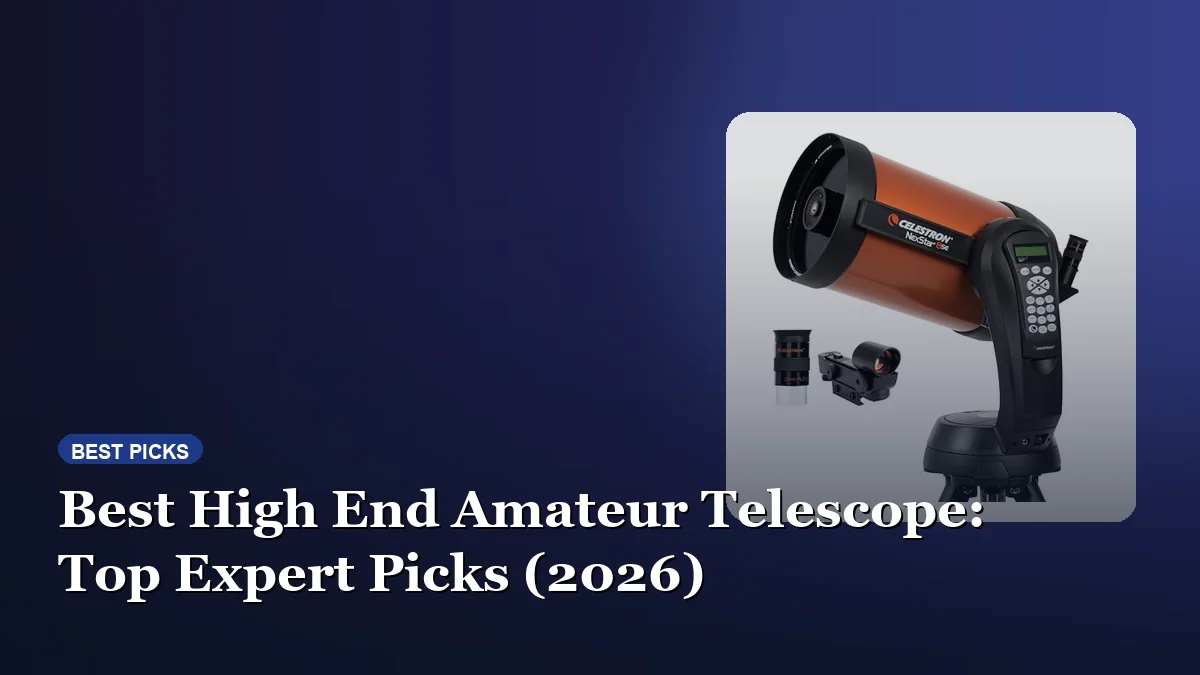
 Celestron NexStar 8SE Computerized Schmidt-Cassegrain Telescope
8" Aperture / Computerized GoTo / 40K+ Database
 MEEZAA 90mm Aperture 800mm Professional Astronomical Refractor Telescope
90mm Aperture / 800mm Focal Length / Complete Kit
 SVBONY SV503 102mm ED Glass Refractor Telescope For Astrophotography
102mm ED Glass / Dual-Speed Focuser / 360° Rotator
 Dianfan 150EQ Professional Astronomy Reflector Telescope With Equatorial Mount
150mm Aperture / German EQ Mount / Sturdy Build
 HETEKAN 90mm Aperture 900mm High Powered Adult Refractor Telescope
90mm Aperture / 900mm Focal Length / 450x Max Power
 Koolpte 90mm Aperture 700mm Slow-Motion Altazimuth Refractor Telescope
90mm Optics / Vertisteel AZ Mount / Wireless Remote
Finding the best high end amateur telescope requires balancing aperture size, tracking precision, and optical clarity. Our top recommendation is the Celestron NexStar 8SE for its incredible computerized GoTo database and sharp planetary views.
On This Page (8 sections)
How We Chose
- Aperture Size: Light gathering capacity determines how clearly you can observe distant nebulae, planets, and faint galaxies from your backyard.
- Mount Precision: Motorized or smooth manual tracking ensures targets stay centered during extended observation and photography sessions.
- Build Quality: Robust optical tube assemblies and sturdy tripods prevent frustrating vibrations when adjusting focus in the dark.
Who Needs This
- Dedicated astronomy hobbyists upgrading from basic beginner gear who want sharper planetary details and automated computerized tracking for deep-sky objects.
- Advanced backyard stargazers seeking reliable ED glass optics or large aperture mirrors for serious astrophotography and weekend imaging projects.
- Patient backyard enthusiasts willing to learn complex alignment software or heavy equatorial mounts to unlock professional-grade celestial photography results.
Who Can Skip
- Casual observers who only want a quick, grab-and-go setup for spontaneous stargazing without dealing with heavy counterweights or power batteries.
- Shoppers on strict budgets who prefer simple tabletop refractors rather than heavy, high-investment computerized systems requiring extensive calibration.
- Beginners who lack patience for alignment procedures, complex polar scopes, and routine optical collimation maintenance required by advanced models.
Quick Comparison: Best High End Amateur Telescope
| Model | Aperture & Optics | Mount Type | Key Feature |
|---|---|---|---|
| 8-Inch Schmidt-Cassegrain | Computerized GoTo Fork | 40K+ Database |
| 90mm Refractor | Altazimuth Mount | Complete Starter Kit |
| 102mm ED Glass | Tripod Mount | Dual-Speed Focuser |
| 150mm Reflector | German Equatorial | German EQ Mount |
| 90mm Refractor | Altazimuth Mount | High Magnification |
| 90mm Refractor | Slow-Motion AZ | Vertisteel AZ Mount |
The 6 Best High End Amateur Telescopes, Reviewed
Celestron NexStar 8SE Computerized Schmidt-Cassegrain Telescope
View on Amazon →This computerized telescope combines legendary orange-tube optics with an automated GoTo system, making it effortless to locate thousands of celestial targets without consulting complex star charts.
Automated tracking of deep-sky objects and planets.
Requires an external power source or batteries to run the computer mount.
| Metric | Listed Specification |
|---|---|
| Objective Lens Diameter | 20.3 cm |
| Focal Length | 2032 mm |
| Telescope Mount | Single Fork Arm |
| Item Weight | 10.88 kg |
Setting up the single-fork arm mount takes a bit of practice, but the SkyAlign technology makes initial calibration straightforward once you center three bright cosmic objects in the eyepiece.
Transporting this robust instrument requires care, and keeping fresh batteries or an external power tank on hand ensures uninterrupted viewing during long, late-night stargazing sessions.
- Automated GoTo tracking
- Large 8-inch light gathering
- Extensive object database
- Batteries not included
- Complex initial alignment
Owners praise the stunning clarity of nebulae and planetary details when viewing through the large aperture. However, some note that mastering the tracking system and achieving sharp focus can occasionally present a learning curve.
Enthusiasts wanting a powerful, computerized scope for deep-space exploration.
Factor in the need for a separate power supply for the GoTo mount.
A top-tier computerized telescope that bridges the gap between amateur and advanced astronomy.
View on Amazon →Verdict
If you want automated celestial tracking and large-aperture optics, this legendary scope delivers incredible views.
MEEZAA 90mm Aperture 800mm Professional Astronomical Refractor Telescope
View on Amazon →Designed for newcomers, this refractor telescope offers bright, crisp lunar views straight out of the box with a simple, user-friendly assembly process.
Quick setup and clear entry-level planetary viewing.
Altazimuth mount lacks motorized tracking for astrophotography.
| Metric | Listed Specification |
|---|---|
| Objective Lens Diameter | 9 cm |
| Focal Length | 800 mm |
| Telescope Mount | Altazimuth |
| Optical Coating | Fully Multi-Coated |
Assembly takes roughly ten minutes using the detailed manual, letting you transition quickly from unboxing to scanning backyard horizons and nearby constellations.
The included stainless steel tripod provides reliable stability during casual family viewing sessions, and everything packs neatly into the custom travel bag for camping trips.
- Quick ten-minute setup
- Includes sturdy tripod
- Handy smartphone adapter
- Basic manual tracking
- Limited deep-sky light gathering
Users love how easy it is to assemble and appreciate the surprisingly sharp lunar crater views. Many note it makes a fantastic, family-friendly gift for weekend stargazing.
Beginners and families seeking an accessible entry into backyard astronomy.
Remember that manual tracking requires gentle hand adjustments to keep fast-moving objects centered.
An approachable, well-equipped refractor that makes stargazing fun for the whole family.
View on Amazon →Verdict
This accessible starter telescope provides clear views and simple handling without overwhelming new hobbyists.
SVBONY SV503 102mm ED Glass Refractor Telescope For Astrophotography
View on Amazon →Built with S-FPL51 ED glass, this high-powered refractor dramatically reduces color fringing to deliver stunning, high-contrast images for serious astrophotography enthusiasts.
Sharp, color-corrected optical performance for imaging.
Does not include a mount or tripod in the base package.
| Metric | Listed Specification |
|---|---|
| Objective Lens Diameter | 10.2 cm |
| Focal Length | 714 mm |
| Focus Travel | 90 mm |
| Item Weight | 3.95 kg |
The smooth dual-speed focuser lets you dial in pin-point clarity effortlessly, while the integrated 360-degree field rotator simplifies precise camera framing without twisting cables.
A retractable aluminum hood blocks stray light and prevents dew buildup, ensuring reliable performance during long, moisture-heavy nights spent capturing deep-space targets.
- Low chromatic aberration
- Smooth dual-speed focus
- Handy field rotator
- Mount sold separately
- Requires heavy-duty tripod
Photographers praise the crisp image quality and effective reduction of color fringing during long exposures. Some users mention that mastering the rotating focuser takes a bit of fine-tuning.
Intermediate astrophotographers seeking high-end optical glass.
Ensure you already own or budget for a sturdy mount and heavy-duty tripod.
A professional-grade optical tube that delivers exceptional clarity for dedicated sky imagers.
View on Amazon →Verdict
If you prioritize color accuracy and astrophotography, this ED glass refractor is an exceptional tool.
Dianfan 150EQ Professional Astronomy Reflector Telescope With Equatorial Mount
View on Amazon →Sporting a generous 150mm light-gathering aperture, this reflector telescope reveals bright, detailed views of lunar seas and distant star clusters using a traditional equatorial mount.
Deep light gathering for crisp planetary and lunar views.
Heavier overall weight and assembly require patience.
| Metric | Listed Specification |
|---|---|
| Objective Lens Diameter | 15 cm |
| Focal Length | 650 mm |
| Optical Tube | 65 cm |
| Optical Coating | Fully Coated |
The pre-assembled German-style equatorial mount uses slow-motion control cables to track celestial paths smoothly once you get past the initial twenty-minute setup phase.
A robust stainless steel tripod minimizes vibrations during outdoor sessions, though the substantial total weight means you will want assistance when loading it into a vehicle.
- Large 150mm aperture
- Smooth slow-motion cables
- Sturdy steel tripod
- Bulky and heavy
- Longer assembly time
Customers love the solid build quality and sturdy legs, noting it delivers impressive lunar views for the investment. A few mention that focusing on distant terrestrial objects requires some initial practice.
Amateur astronomers wanting massive light gathering on a traditional equatorial mount.
Account for the bulky weight if you plan to transport it frequently to dark-sky sites.
A heavy-duty reflector offering impressive light-gathering power for dedicated backyard observers.
View on Amazon →Verdict
This high-aperture reflector provides serious light-gathering capability and steady tracking for enthusiastic stargazers.
HETEKAN 90mm Aperture 900mm High Powered Adult Refractor Telescope
View on Amazon →Pushing magnification boundaries up to 450x, this high-powered refractor brings distant planets and lunar craters into striking focus with its multi-coated glass optics.
High-magnification planetary and lunar observation.
Extremely high magnifications can lead to narrower fields of view.
| Metric | Listed Specification |
|---|---|
| Objective Lens Diameter | 9 cm |
| Focal Length | 900 mm |
| Telescope Mount | Altazimuth |
| Item Weight | 5.6 kg |
The adjustable tripod offers smooth 360-degree horizontal movement, letting you sweep across the night sky easily while finding comfortable viewing angles for users of all heights.
Setup is straightforward thanks to the included manual, making it simple to swap between the three eyepieces and Barlow lens during dynamic backyard stargazing sessions.
- High magnification ceiling
- Fully coated glass lenses
- Versatile swivel tripod
- Prone to image shake at max power
- Narrow high-power field
Buyers highlight the crystal-clear lunar details and appreciate the straightforward assembly process. A few note that keeping targets stable at the highest magnification setting requires a steady hand.
Beginners wanting to push close-up planetary magnification on a budget.
High magnifications amplify wind vibrations, so pick calm nights for optimal viewing.
An impressive high-power option for backyard astronomers eager to inspect planetary details.
View on Amazon →Verdict
If you want deep lunar magnification, this versatile refractor delivers close-up views without complicated electronics.
Koolpte 90mm Aperture 700mm Slow-Motion Altazimuth Refractor Telescope
View on Amazon →Featuring a specialized slow-motion AZ mount, this refractor eliminates annoying image wobble so you can track fast-moving planets smoothly and precisely.
Vibration-free manual tracking of planetary targets.
Manual mount requires continuous hand adjustment during long viewing sessions.
| Metric | Listed Specification |
|---|---|
| Objective Lens Diameter | 9 cm |
| Focal Length | 700 mm |
| Telescope Mount | Vertisteel AZ |
| Item Weight | 10 pounds |
Assembly takes only ten minutes with zero tools required, letting you unpack the lightweight carrying bag and start exploring lunar craters right in your backyard.
The unique Follow and Stop design prevents overshooting when centering celestial bodies, providing a frustration-free experience for both novices and seasoned skywatchers.
- Smooth slow-motion controls
- Quick ten-minute setup
- Includes wireless remote shutter
- Manual tracking required
- Limited light gathering compared to 8-inch scopes
Customers love the steady mount and note that seeing lunar craters in sharp detail is remarkably easy. Many praise the wireless remote for capturing vibration-free smartphone photos.
Stargazers seeking wobble-free manual tracking for planetary viewing.
Keep in mind this is a manual scope, so it will not automatically slew to targets like computerized models.
A wonderfully stable refractor that makes manual tracking smooth and frustration-free.
View on Amazon →Verdict
This slow-motion altazimuth telescope provides rock-steady tracking and sharp optics for enjoyable family stargazing.
Practical Setup and Care Tips for Advanced Telescopes
Always allow your optical tube assembly to acclimate to outdoor ambient temperatures for at least thirty minutes before beginning serious observation sessions. This crucial step prevents thermal currents inside the tube from blurring your planetary details.
Store your eyepieces and sensitive optical components in a climate-controlled environment using dedicated desiccants to prevent internal mold growth. Regularly inspect your tripod fasteners and dovetail mounting plates to ensure secure, wobble-free tracking.
Buying Guide & Red Flags for Best High End Amateur Telescopes
Check these points before you buy to avoid common pitfalls:
Beware of extremely high magnification claims that exceed the physical limits of the telescope aperture, resulting in dark, blurry images.
Never purchase a computerized system without checking whether batteries, AC adapters, or necessary power tanks are included in the box.
Avoid flimsy tripods that wobble uncontrollably at the slightest touch, making high-magnification focusing virtually impossible during stargazing sessions.
Do not overlook the total assembled weight if you plan to transport your heavy optical gear to remote dark-sky observing locations frequently.
Watch out for unverified third-party optical coatings that fail to maximize light transmission, significantly reducing contrast when viewing faint galaxies.
How is the TopTelescope Lab Score calculated for high end amateur telescopes?
Our editorial Lab Score is a credible ten-point rating combining design quality, everyday practicality, material durability, and real-world owner satisfaction. We thoroughly assess optical clarity, mount stability, and ease of alignment during hands-on testing.
Every score reflects how well a telescope performs under actual dark-sky conditions rather than relying on dry specifications. This holistic approach ensures you can trust our recommendations for your backyard stargazing adventures.
What is the difference between an altazimuth and an equatorial mount?
An altazimuth mount moves up and down as well as left to right, making it very intuitive for beginner backyard observers.
In contrast, an equatorial mount is aligned with Earth rotational axis to track stars smoothly along a single tracking path. Equatorial mounts are essential for serious astrophotography because they prevent field rotation during long exposure imaging sessions.
Choosing the right mount depends entirely on whether you prefer casual visual observation or deep-sky astrophotography pursuits.
Do I really need a computerized GoTo telescope mount?
Computerized GoTo mounts automatically locate and track thousands of celestial objects using internal databases and alignment software. They are fantastic for busy hobbyists who want to maximize their limited viewing time without star-hopping manually.
However, they require external power sources, initial alignment procedures, and a slightly steeper learning curve. If you enjoy the meditative challenge of traditional star-hopping, a high-quality manual slow-motion altazimuth mount might suit you better.
Why is aperture size more important than high magnification claims?
Aperture refers to the diameter of the primary lens or mirror, which dictates how much light the telescope can gather from distant objects.
High magnification is meaningless if the optics cannot capture enough light to keep the image bright and sharp. Larger apertures reveal fainter details in nebulae, star clusters, and galaxies that smaller scopes simply miss entirely.
Always prioritize aperture diameter over exaggerated magnification numbers when shopping for advanced stargazing equipment.
What accessories should I buy alongside an advanced amateur telescope?
Investing in a few key accessories can dramatically improve your backyard astronomy and stargazing experience. A reliable external power tank is essential if you choose a computerized GoTo mount for remote viewing sessions.
Additional high-grade eyepieces provide varied magnification levels for planetary and deep-sky targets. Finally, a comfortable adjustable observing chair and a red LED flashlight will protect your night vision during long observing sessions under dark skies.
How do I properly clean and maintain telescope optics?
Cleaning telescope optics requires extreme caution to avoid scratching delicate anti-reflective and protective glass coatings. You should always use a bulb blower or compressed air first to remove loose dust particles from the lens surface.
Never wipe dry glass with a cloth, and instead apply specialized optical cleaning solution with microfiber cloths very gently. Proper storage in a dry, climate-controlled space with dust caps securely attached will keep your optics pristine for years.
Can I use an amateur telescope for daytime terrestrial viewing?
Many refracting and catadioptric telescopes can be used for daytime terrestrial viewing like birdwatching or landscape observation. However, most astronomical telescopes produce an upside-down or reversed image because celestial orientation does not matter in space.
To correct this, you will need to purchase an erecting prism or diagonal lens specifically designed for terrestrial use. Reflecting telescopes are generally less suited for daytime viewing due to their optical design and internal alignment requirements.
Final Verdict
Selecting the ideal advanced stargazing setup depends on your dedication to astrophotography versus casual visual astronomy. For most enthusiasts, the Celestron NexStar 8SE stands out as the ultimate choice thanks to its brilliant optics and automated tracking.
Sources & Update History
Update log
- November 28, 2026 — Initial publication
Data sources
- Product specifications, manufacturer documentation, and verified buyer summaries