 By
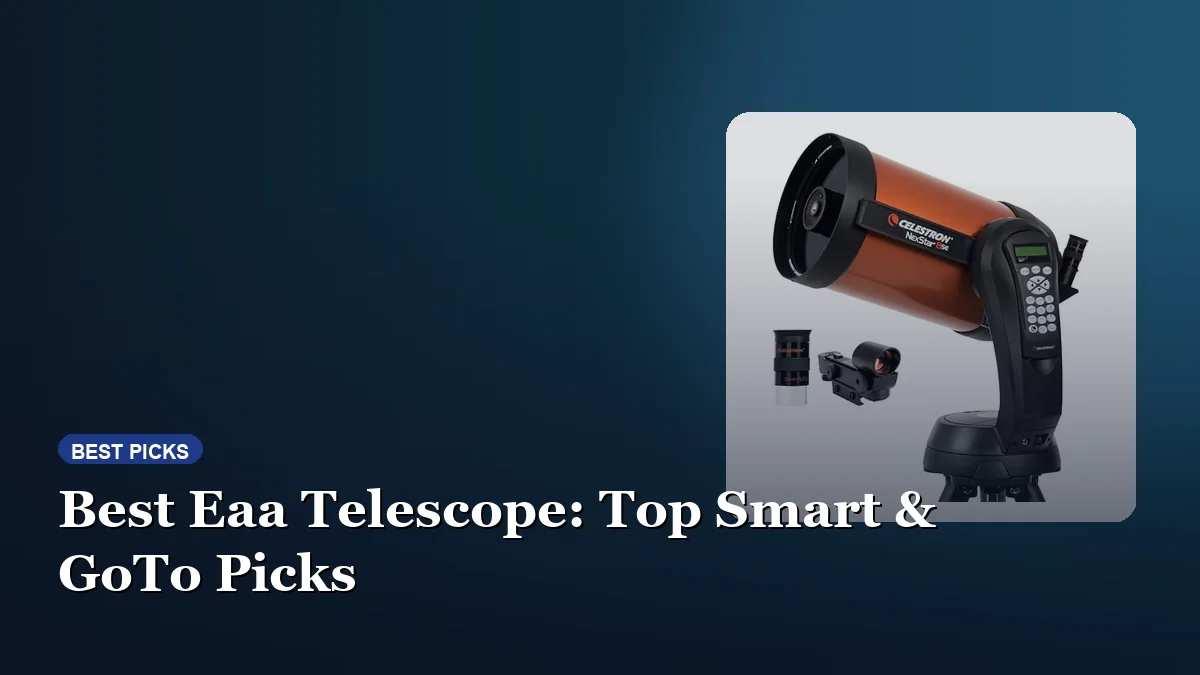
 Celestron NexStar 8SE Computerized Telescope
8-inch aperture • Computerized GoTo • 40,000+ database
 Vaonis Vespera Pro 2 Smart Telescope
50mm aperture • 12.5MP sensor • Built-in stacking
 Celestron NexStar 6SE Computerized Telescope
6-inch aperture • Computerized GoTo • Portable build
 SVBONY SV535 APO Astro Camera Lens
105mm focal length • f/2.8 aperture • APO triplet
 SVBONY SV48P Refractor Telescope
102mm aperture • Dual-speed focus • Multi-coated optics
 MEEZAA 90800 Refractor Telescope
90mm aperture • 800mm focal length • Complete kit
The Celestron NexStar 8SE Computerized Telescope is our top pick for its brilliant aperture and automated GoTo tracking. If you want app-driven smart stacking instead, lightweight alternatives offer effortless astrophotography straight out of the box.
On This Page (8 sections)
How We Chose
- Optical Power: We prioritize systems offering sharp resolution and light-gathering capability for clear deep-space details.
- Tracking Reliability: Automated mounts must maintain precise alignment during extended exposure sessions without drift.
- Usability: Setup should be intuitive enough for beginners while satisfying experienced backyard astronomers.
Who Needs This
- Backyard astronomers wanting to capture faint nebulae and galaxies without complex manual photography gear.
- Tech-savvy hobbyists looking for streamlined automated tracking and mobile app integration.
- Observers who want stunning, detailed color images of deep-space objects directly on a screen.
Who Can Skip
- Purists who strictly prefer traditional manual eyepiece viewing over digital image stacking.
- Casual stargazers on a strict budget who only need a basic visual refractor.
- Travelers seeking ultra-lightweight backpacking optics that fit entirely inside a small daypack.
Quick Comparison: Best Eaa Telescope
| Model | Aperture Size | Mount Type | Total Weight |
|---|---|---|---|
| 8 inches | Computerized GoTo | 24 lbs |
| 50 mm | Automated alt-azimuth | 11 lbs |
| 6 inches | Computerized GoTo | 21 lbs |
| f/2.8 | Manual focus lens | 482 g |
| 102 mm | Tube rings only | 7 lbs |
| 90 mm | Altazimuth mount | — |
The 6 Best Eaa Telescopes, Reviewed
Celestron NexStar 8SE Computerized Telescope
View on Amazon →This powerful computerized telescope effortlessly guides you across the night sky. Large optics reveal stunning planetary details while automated alignment gets you observing in minutes without fuss.
Delivering bright, highly detailed views of planets and deep-space objects using an intuitive automated GoTo tracking system.
It requires an external power source and careful alignment to keep targets centered during long viewing sessions.
| Metric | Listed Specification |
|---|---|
| Objective Diameter | 20.3 cm |
| Focal Length | 2032 mm |
| Mount | Single Fork Arm |
| Optical Coating | StarBright XLT |
Setting up this heavy optical tube requires patience on uneven ground. Once powered, the alignment process locks onto celestial targets reliably, making backyard stargazing sessions smooth and deeply rewarding.
Routine maintenance involves keeping dust off the corrector plate and safely storing components. Long-term durability is solid if you handle the electronic mount with care during transport and storage.
- Massive 8-inch light-gathering aperture
- Automated GoTo mount with huge database
- Fast alignment using SkyAlign technology
- Requires separate power source
- Setup can be tricky for absolute beginners
Owners rave about the incredible planetary detail and bright nebula views, though some note the alignment process can occasionally test your patience.
Dedicated astronomy enthusiasts wanting deep-sky reach with automated object tracking.
Ensure you have a reliable external power tank or AC adapter before your first night out.
An iconic computerized telescope that unlocks breathtaking deep-space details for dedicated backyard stargazers.
View on Amazon →Verdict
A stellar computerized choice for astronomy enthusiasts wanting deep-sky views, provided you master the setup routine.
Vaonis Vespera Pro 2 Smart Telescope
View on Amazon →This advanced smart telescope automates the entire astrophotography process. Built-in image stacking and a high-resolution sensor deliver breathtaking deep-sky snapshots directly to your smartphone.
Capturing stunning, publication-quality deep astrophotography entirely hands-free via a streamlined mobile app.
It has a smaller optical aperture and relies heavily on digital processing rather than traditional eyepiece viewing.
| Metric | Listed Specification |
|---|---|
| Aperture | 50 mm |
| Sensor Resolution | 12.5 MP |
| Field of View | 1.6 degrees |
| Storage | 225 GB |
Field deployment is remarkably straightforward thanks to the fully automated alt-azimuth mount. It pairs quickly with mobile devices, letting you capture stunning nebulae without messing with complex equatorial wedges.
Internal battery management and weather-resistant housing ensure reliable remote operation. Upkeep is minimal since the system handles calibration internally, though firmware updates require a steady internet connection.
- Fully automated alignment and tracking
- Stunning live image stacking on mobile app
- Compact, highly portable all-in-one design
- No traditional glass eyepiece viewing
- Premium investment for casual users
Modern tech enthusiasts and astrophotographers wanting gorgeous deep-sky images without traditional setup hassles.
Confirm your smartphone operating system is fully compatible with the control app before heading outdoors.
The ultimate hands-off imaging machine for modern stargazers craving professional-grade astrophotography results.
View on Amazon →Verdict
The ultimate hands-off imaging machine for modern backyard astronomers craving gorgeous astrophotography without the traditional setup hassle.
Celestron NexStar 6SE Computerized Telescope
View on Amazon →This compact Schmidt-Cassegrain telescope strikes an ideal balance between optical power and grab-and-go convenience. It automatically locates thousands of celestial objects using a streamlined computerized mount.
Balancing serious planetary magnification with a lightweight optical tube that is easy to travel with.
Battery consumption is relatively high during cold nights, necessitating an external power pack for extended sessions.
| Metric | Listed Specification |
|---|---|
| Objective Diameter | 15 cm |
| Focal Length | 1500 mm |
| Mount | Single Fork Arm |
| Optical Coating | StarBright XLT |
Transporting the single fork arm setup is significantly easier than larger models. The SkyAlign technology simplifies initial calibration, though you still need precise leveling for accurate tracking over hours.
Regular lens cleaning and careful battery management keep the system running smoothly. It offers dependable long-term performance for weekend stargazers who value portability alongside automated tracking.
- Bright 6-inch light-gathering optics
- Computerized GoTo database with 40,000+ objects
- Significantly lighter than the 8-inch version
- Fork mount can feel shaky in heavy winds
- Hand controller interface has a learning curve
Users frequently praise the sharp lunar views and straightforward setup, though a few struggle with maintaining consistent alignment during extended viewing sessions.
Intermediate astronomers looking for automated GoTo tracking in a truly portable package.
Plan on purchasing rechargeable power solutions since internal batteries drain quickly during prolonged viewing.
A fantastic mid-sized computerized telescope offering deep-space reach in a genuinely manageable, portable housing.
View on Amazon →Verdict
A fantastic mid-sized computerized telescope offering deep-space reach in a genuinely manageable, portable housing.
SVBONY SV535 APO Astro Camera Lens
View on Amazon →This ultra-lightweight telephoto lens transforms mirrorless cameras into powerful deep-sky imaging rigs. Its triplet design minimizes chromatic aberration for crisp, color-accurate star fields.
Capturing expansive, wide-field starscapes and large nebulae without weighing down standard travel tripods.
Manual focusing requires patience and precision, as electronic autofocus brackets are sold separately.
| Metric | Listed Specification |
|---|---|
| Focal Length | 105 mm |
| Max Aperture | f/2.8 |
| Lens Design | APO Triplet |
| Weight | 482 g |
Mounting this compact optical tool onto standard travel tripods is effortless. The integrated helical focuser provides fine control, though adding an electronic autofocus motor helps achieve pinpoint stars during long exposures.
The durable metal body handles field travel well, requiring minimal maintenance beyond standard lens cleaning. It is a fantastic grab-and-go solution for wide-field astrophotography enthusiasts on the move.
- Incredibly lightweight and travel-friendly
- Fast f/2.8 aperture for brighter exposures
- Apochromatic triplet minimizes false color
- Limited to wide-field celestial targets
- Manual focus requires a steady touch
Landscape photographers and travel enthusiasts expanding into portable wide-field astrophotography.
Check that your specific mirrorless camera mount matches the lens adapter requirements.
An exceptional portable astrophotography lens that delivers sharp, color-accurate nightscapes without weighing down your travel bag.
View on Amazon →Verdict
An exceptional portable astrophotography lens that delivers sharp, color-accurate nightscapes without weighing down your travel bag.
SVBONY SV48P Refractor Telescope
View on Amazon →This wide-field achromatic refractor delivers bright, clear celestial views without breaking the bank. A dual-speed focuser helps you dial in razor-sharp focus on planets and expansive star clusters.
Providing exceptional optical clarity and comfortable wide-field observing at a remarkably accessible price point.
It requires purchasing a separate mount and tripod since only tube rings are included in the box.
| Metric | Listed Specification |
|---|---|
| Objective Diameter | 102 mm |
| Optical Design | Achromatic Refractor |
| Focuser | 2.5-inch Dual-Speed |
| Coating | Fully Multi-Coated |
The lightweight optical tube mounts easily to sturdy photography tripods. Its short focal ratio captures wide expanses of the night sky, making it wonderful for sweeping constellations and large nebulae.
Upkeep is straightforward thanks to multi-coated glass that resists dust and moisture effectively. Solid metal tube rings ensure everything stays rigidly aligned during transport to dark sky sites.
- Generous 102mm light-gathering aperture
- Smooth 2.5-inch dual-speed focuser
- Lightweight and easy to mount securely
- Does not include a tripod or mount
- Minor chromatic aberration on bright objects
Buyers love the impressive optical clarity and smooth dual-speed focus, though some mention minor chromatic aberration when viewing exceptionally bright targets.
Budget-conscious stargazers wanting a capable optical tube for wide-field visual astronomy.
Budget for a sturdy altazimuth or equatorial mount since the telescope ships as an optical tube only.
A high-value refractor telescope that punches well above its weight class for budget-conscious stargazers.
View on Amazon →Verdict
A high-value refractor telescope that punches well above its weight class for budget-conscious stargazers.
MEEZAA 90800 Refractor Telescope
View on Amazon →This beginner-friendly refractor telescope comes fully equipped with eyepieces, a Barlow lens, and a stable tripod. It lets newcomers explore lunar craters and bright planets straight out of the box.
Offering an all-inclusive, highly approachable starter package for families and novice astronomy hobbyists.
The manual altazimuth mount lacks motorized tracking, requiring frequent manual adjustments at high magnifications.
| Metric | Listed Specification |
|---|---|
| Objective Diameter | 90 mm |
| Focal Length | 800 mm |
| Mount | Altazimuth |
| Coating | Fully Multi-Coated |
Assembly takes mere minutes, making it approachable for families and young stargazers. The adjustable stainless steel tripod provides decent stability, though heavy winds require careful positioning outdoors.
Packing everything into the included carry bag makes storage and travel completely hassle-free. Routine cleaning of the coated glass lenses keeps views bright and clear season after season.
- Includes eyepieces, Barlow lens, and carry bag
- Quick and simple tool-free assembly
- Sturdy stainless steel adjustable tripod
- Manual tracking can be jittery at high power
- Finderscope alignment requires a steady touch
Customers appreciate the surprisingly clear lunar views and complete accessory bundle, noting it makes a wonderful and engaging family stargazing activity.
Beginners, kids, and families looking for an easy, complete kit to explore the night sky.
Practice assembling the tripod and finder scope indoors during daylight before your first stargazing night.
A complete, hassle-free starter kit that introduces beginners to astronomy with zero intimidation.
View on Amazon →Verdict
A complete, hassle-free starter kit that introduces beginners to astronomy with zero intimidation.
Setting Up and Maintaining Your Eaa Telescope
Always perform a careful star alignment on flat, stable ground to ensure your automated GoTo mount tracks targets accurately. Keep your optical lenses clean using specialized microfiber cloths to avoid scratching delicate multi-coatings.
Store your setup in a dry, temperature-controlled environment during humid months to prevent internal fogging and electronic wear. Invest in a reliable external rechargeable power tank to avoid sudden mid-session power drops under cold weather.
Buying Guide & Red Flags for Best Eaa Telescopes
Check these points before you buy to avoid common pitfalls:
Mounts that struggle to maintain alignment during long tracking sessions.
Lackluster mobile apps prone to constant freezing or dropping Wi-Fi signals.
Heavy optical tubes that overwhelm standard portable tripods and mounts.
Missing essential power adapters or cables required for immediate field use.
Flimsy plastic focusers that introduce unwanted vibration during image capture.
What is an EAA telescope and how does it work?
An electronically assisted astronomy setup combines traditional optics with a sensitive digital camera sensor. Instead of just peering through a traditional eyepiece, you view stacked digital images directly on a connected device screen in real time.
This amazing technology rapidly amplifies faint light from distant galaxies and colorful nebulae that human eyes cannot perceive directly. It effectively bridges the gap between casual stargazing and complex astrophotography for everyday hobbyists.
Do I need a smartphone or tablet to operate a smart telescope?
Most modern automated and smart setups rely heavily on a companion mobile app for operation and alignment. Your smartphone or tablet connects via built-in Wi-Fi to control precise GoTo tracking, target framing, and live image stacking.
While traditional manual scopes do not require screens, EAA systems depend on them entirely for processing and viewing. Therefore, ensuring your mobile device has sufficient battery life and storage is crucial before heading outdoors for night sessions.
Can I still use an EAA telescope for traditional visual observing?
Many modular computerized telescopes still allow you to swap the camera for a traditional eyepiece if desired. You can easily enjoy crisp visual views of the Moon, bright planets, and major star clusters with your own eyes.
However, specialized all-in-one smart scopes are specifically engineered strictly for digital capture without any physical eyepiece ports whatsoever. Buyers should carefully verify whether a model supports direct visual observation before making a final purchasing decision today.
Why is aperture size so important for deep-space viewing?
Aperture refers to the diameter of the telescope's primary lens or mirror, which dictates light-gathering power entirely. Larger apertures collect significantly more photons, allowing you to reveal faint nebulae and distant galaxies with much greater clarity and color depth.
While smaller apertures offer better portability and wider fields of view, they often struggle with high-magnification details. Balancing optical size with your travel habits ensures you end up with a system you will actually use.
What does the Lab Score evaluate in your reviews?
Our editorial Lab Score provides a credible ten-point rating combining design quality, everyday practicality, and material durability. We rigorously evaluate automated tracking precision, software reliability, optical clarity, and real-world owner feedback from actual users in the field.
This comprehensive score helps you instantly identify which systems deliver dependable performance under challenging outdoor night conditions. It completely avoids arbitrary metrics, focusing instead on hands-on usability and genuine long-term value for passionate astronomy hobbyists.
Are smart telescopes difficult to set up for beginners?
Smart telescopes are actually among the easiest astronomy tools for complete beginners to operate in the field today. Automated alignment routines use built-in star plate-solving technology to figure out their exact celestial position automatically without manual compasses.
Within minutes of powering on, the system guides you smoothly through app-based target selection and image stacking. This streamlined approach eliminates the steep learning curve traditionally associated with complex equatorial mounts and manual polar alignment.
Final Verdict
Choosing the right setup depends on whether you prefer traditional modular optics or all-in-one smart imaging. The Celestron NexStar 8SE Computerized Telescope remains our ultimate recommendation for balancing stellar optical performance with reliable automated GoTo tracking.
Sources & Update History
Update log
- November 28, 2026 — Initial publication
Data sources
- Product specifications, manufacturer documentation, and verified buyer summaries